 Bulletin Board
Questions about the website? Announcements! Information for the membership!
Send an email to President, Karen Nelson karenwnelson@gmail.com
or Webmaster, Sid Underwood sidunderwood@prodigy.net.
Send a letter or email and we can post it to this webpage.
Contact information is on the Officers webpage.
Posted 1/27/18
Subject: Search for Info or Photos of T/Sgt Louis C. Hazay or Crew Photo of B-17F "Lady Be Good" of the 429th Squadron
Please contact me if you have any information or photos regarding Louis Hazay or his crew to go with his medals.
WIENER NEUSTADT, AUSTRIA -
MISSION NO. 92 - NOVEMBER 2, 1943
MISSING AIR CREW REPORT: A/C #42-3341 - "LADY BE GOOD" - 429TH SQUADRON
2nd Lt. Lester L. Gillan, 0-730452, P. (KIA)
2nd Lt. Frank D. Counihan, 0-735058, CPo (KIA)
2nd Lt. Peter H. Diglio, 0-800646, N. (POW)
2nd Lt. Merideth D. Fink, 0-735300, B. (POW)
T/Sgt. Louis C. Hazay, 31167401, VIT. (KIA)
S/Sgt Claude H. Denton, 34348857, LIT. (KIA)
S/Sgt Henry F. Reedy, 35350463, RIW. (KIA)
S/Sgt Anthony J. DeLatte, 18134212, LIW. (POW)
S/Sgt Howard L. Rees, 20247716, T/G. (POW)
T/Sgt. Joseph R. Hagerman, 19123924, RIO. (KIA)
Thank you,
Jon Dray
Posted 4/21/17
Subject: Lt. Clarence W. Southern, 96th Squadron (main subject of the "Range! Fire!" war story on this website)
I was very happy to find your website and the
tribute to my great uncle, Lt. Clarence W. Southern. Getting to read the
story of the battle and see the drawing of the plane that he and his crew flew
in is just so incredible. Thank you! Attached are two letters that his
mother, my great aunt, Mae Southern gave to me for safekeeping many years ago.
The first letter (both are V-Mail) is Clarence's last letter home. The postmark
date is Feb 15, 1944. The second letter is the last letter that his parents sent
to him. The postmark date is March 10, 1944. The letter was returned to his
parents, of Childress, TX, with the words: "Missing 3/27/44" written over the
Return to Sender stamp.

David Winfrey
Posted 3/14/17
Subject: Available for Pre-Order on Amazon.com - "Little Minnesota in WWII: The Stories Behind 142 Fallen Heroes from Minnesota's Littlest Towns"
Dear Karen,
Thank you for all your help with Little Minnesota in World War II, now
on Amazon for pre-order and due for release September 5, 2017. The
book is a reality thanks to you and all the other contributors!
All the best,
Jill Johnson
jillj@arvig.net
Posted 2/28/17
Subject: 98 Days of High Adventure - 4/3/44 thru 7/9/44 - Vincent Sterling Werner - Navigator - 96th Bomb Squadron
Survived, I did! It proved to perhaps be the most important period of my life, now closing in on nearly 95 years. What future use this document may have is unknown. Perhaps it will help some great (3rd or more great) grandchild in that year 2094 history class to better appreciate what their ancestors experienced a century and half previous, in year 1944.
Vince Werner
sterlmyrt@q.com
Posted 9/14/16
Subject: Requesting Information - Clarence M. "Cotton" Hunt, Jr - Tail Gunner 429th Bomb Squadron
My brother was Clarence M. "Cotton" Hunt, Jr. He served as a tail gunner in the 429th Squadron of the 2nd Bomb Group at Amendola, Italy and flew on missions from June 13, 1944 until October 12, 1944. I would like to hear from fellow crew members or anyone with information about my brother.
Tommy Hunt
huntt1115@mindspring.com
Posted 5/13/16
Subject: Requesting Information - Cpl. Donald Bruce Torpy - Right Waist Gunner 49th Bomb Squadron
I appreciate your website and have a
request for pictures or information
pertaining to cousin Donald Bruce Torpy.
How may I obtain a picture of my cousin
(Donald) Bruce Torpy, right waist gunner
with 2nd Bomb Group, or perhaps pictures
of Torpy and his Air Crew #42-29638
squad? Cousin Bruce's B-17
heavy bomber "My Aching Back" was shot
down on February 24, 1944 over Steyr,
Austria during "Big Week". Bruce
survived as a POW for over 16 months.
Through internet research, especially
"The Second Was First", I located the
following information about the fate of
Bruce Torpy's B-17 bomber.
15th Air Force, 5th Bomb Wing, 2nd Bomb
Group
CO – Brig. Gen. Charles W. Lawrence
Headquarters: Amendola Air Base,
Foggia, Italy 11/1943-11/1945
Air Crew/Squad - 42-29638 / 49th
Squadron
Name - My Aching Back, B-17F
Original aircraft: MIA Steyr 24
Feb 44 on its 97th mission. Attacked by
fighters, crashed near Fuehl
1st Lt. Frank Glass crew: Little,
Bacsu, Hayes, Garnett, Hancock, (Donald
Bruce) Torpy, Ward, Cooper, Rand
Little, Cooper, Rand were KIA, all the
rest were POW
1st Lt. Frank H. Glass, 0-669701, Pilot
- POW
2nd Lt. Russell L. Little, 0-803520,
Co-Pilot - KIA
2nd Lt. John (NMI) Bacsu, 0-749416,
Navigator - POW
1st Lt. Eugene M. Hayes, 0-5634264,
Bombardier - POW
T/Sgt. Robert M. Garnett, 15082163,
Upper Turret gunner - POW
S/Sgt. Richard L. Hancock, 11044776,
Lower Turret gunner - POW
Cpl. Donald Bruce Torpy, 13021464, Right
Waist gunner - POW
S/Sgt. Edmund F. Ward, 34306211, Left
Waist gunner - POW
S/Sgt. Rex C. Cooper, Jr., 20904544,
Tail gunner - KIA
T/Sgt. Robert M. Rand, 20113061,
Radio Operator - KIA
Any and all information or pictures
provided will be greatly appreciated.
Thanks! Kathryn Willard Conway
conwaykd@gmail.com
Posted 5/13/16
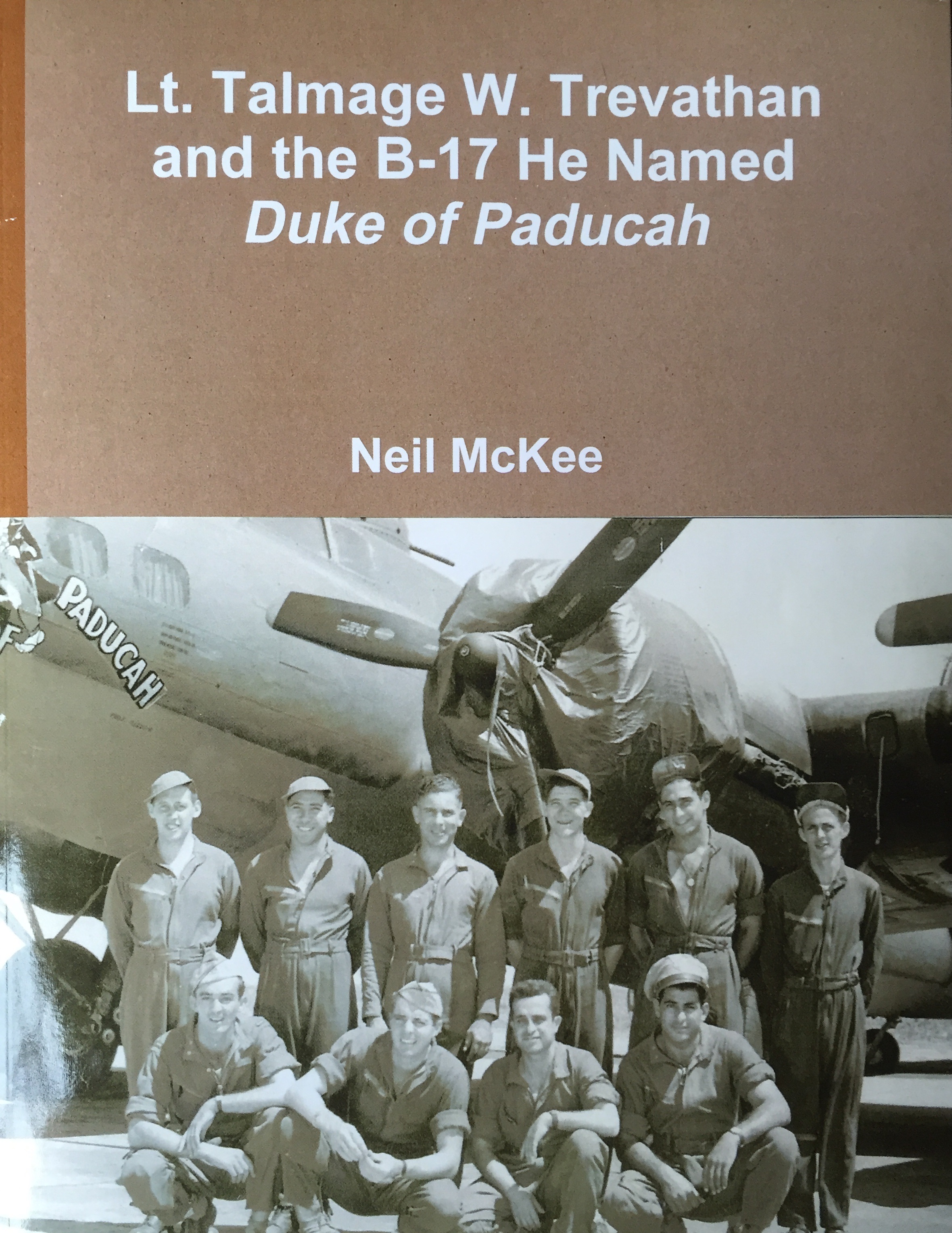
Subject: Requesting Information - Lt. Talmage W. Trevathan - Pilot 96th Bomb Squadron
My uncle was Lt. Talmage W. Trevatha, a B-17 pilot in the 96th Bomb Squadron with the 2nd Bomb Group during WWII. Would it be possible to put a message on your bulletin board asking for information or pictures from any surviving crew members or their relatives. Would appreciate any help you might be able to give me.
Respectfully,
Neil McKee
wnmckee@gmail.com
 |
Posted 5/12/16
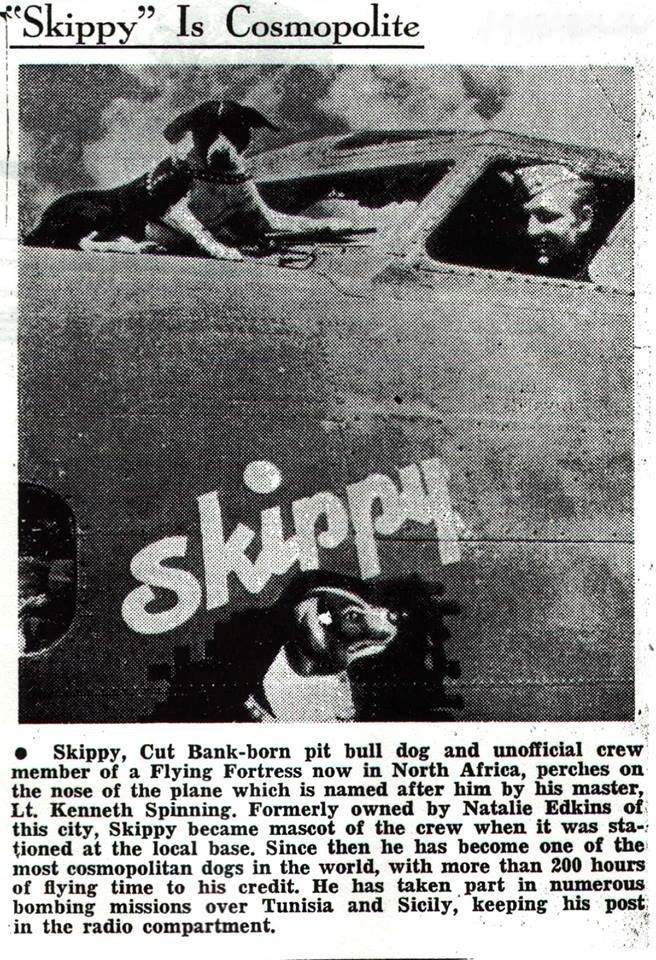
Subject: Skippy the Dog (see "The Story of Skippy" in the "War Stories" webpage)
Was reading your tribute to Capt. Kenneth Spinning and his dog Skippy on the 2nd Bomb Group website today. I wanted to send you this newspaper photo and caption concerning them. The photo shows their B-17 nose art, Skippy and the Captain. I lived in the town mentioned in the caption, "Cut Bank, Montana", when I was a kid. I am assuming the photo was originally posted in the Cut Bank Pioneer Press which is the local paper there. Very sad story about the Captain and Skippy. Have a great week... Nate Wilburn, Great Falls, Montana
 |
Posted 2/20/16
Subject: Requesting Information - 2nd Lt. G.W. Ellerman - Co Pilot 20th Bomb Squadron
My father was a 2nd. Lieutenant B-17 Co- Pilot in Amendola with the 2nd Bomb Group during WWII. Would it be possible to put a message on your bulletin board asking for information or pictures from any surviving crew members or their relatives. Would appreciate any help you might be able to give me.
Respectfully,
George W. Ellerman Jr.
513-451-3503
Cincinnati, Ohio
Posted 9/9/15
Subject: Roy Rigney- Pilot
My name is Don Himsel. I'm a photographer and columnist for The (Nashua) Telegraph in New Hampshire. My regular Tuesday column features old photographs. I find interesting images and stories, return to the spot the image was made and replicate the shot. I blend the two in Photoshop. It's not that unusual to see the technique today, but local readers like the result. This week I featured a photograph from 1939. The plaque in the image has the name of a local man who flew with the 2nd Bomb Group during World War Two. I thought you'd like to see it and read the column. Since you're most likely not subscribers, I posted it on a site I control myself outside of the newspaper. On it are other examples (not all) of what I do. It allows people to get a taste of what I do. If you click on the image, it appears larger.
Regards,
Don Himsel
Posted 9/1/15
Subject: Diary of Lt. T. Michael Sullivan
My Father, Lt. T. Michael Sullivan, was a bombardier in the 429th Sq. from December 1943 thru March 1944 and wrote his day-to-day thoughts in a diary given to him by a relative. I have the original in my possession. I transcribed the diary while comparing its contents with "The Second Was First" by Charles W. Richards. Pretty interesting stuff. For the most part my Father's comments were consistent with the book. I have included with this email that transcription which I completed in 2013 for inclusion in the 2nd Bombardment Association archives.
The last 2nd Bomb Group newsletter mentions an
upcoming convention in Shreveport. Since I live here, let me know if there is
anything that needs to be done. I'll be happy to help.
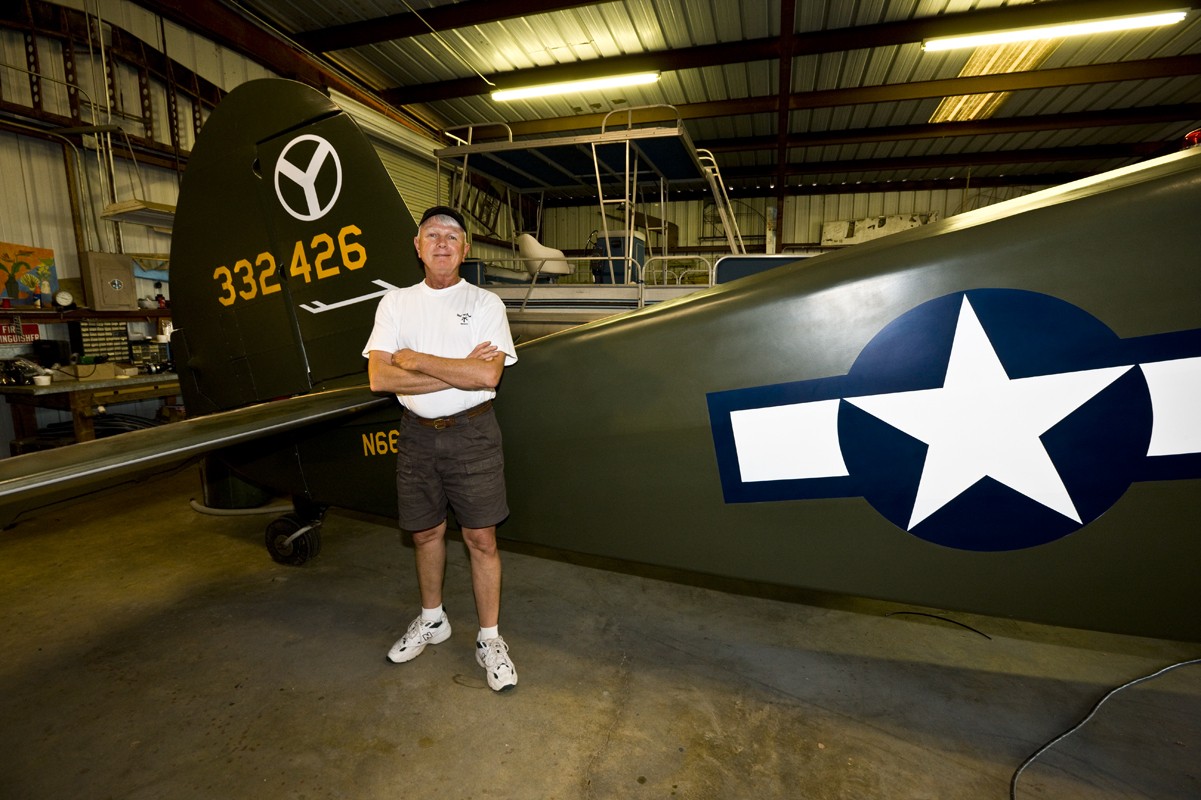
In case you are curious about my email signature art below, I own and fly a 1943
Cessna UC-78B that I marked with the Sq/BG markings of the 2nd/429th. I have no
knowledge of the 429th ever having an aircraft like this but I took the liberty
anyway. I keep it at the Shreveport Downtown Airport, just a mile or so from the
convention hotel.Check out the web page if you have time.
Editors Note - scroll
down to Bulletin Board posting dated 11/10/08 and you'll see a photo of Terry
Sullivan's plane painted with 2nd BG 429th BS markings.
My wife and I are looking forward to meeting all of you this October.
Terry Sullivan

Posted 7/13/15
Subject: Unidentified Photo - Possible 429th Crewman
My late father in law (George W Hess) served in the 429th during WWII and was
stationed in Montana for a while. While my husband and I were going
through some items in my mother in law's house we discovered a professional
photograph of a young soldier. There was no identification on the picture, but
it was taken at Fullmer's Studio in Havre, Montana. I am enclosing a scan
of the picture. If there is anyone you know who recognizes this man, I would be
happy to send the picture to them. I'm sure it would mean more to family.
Sincerely,
Rochelle Hess
rhess333@yahoo.com
.jpg)
Posted 7/13/15
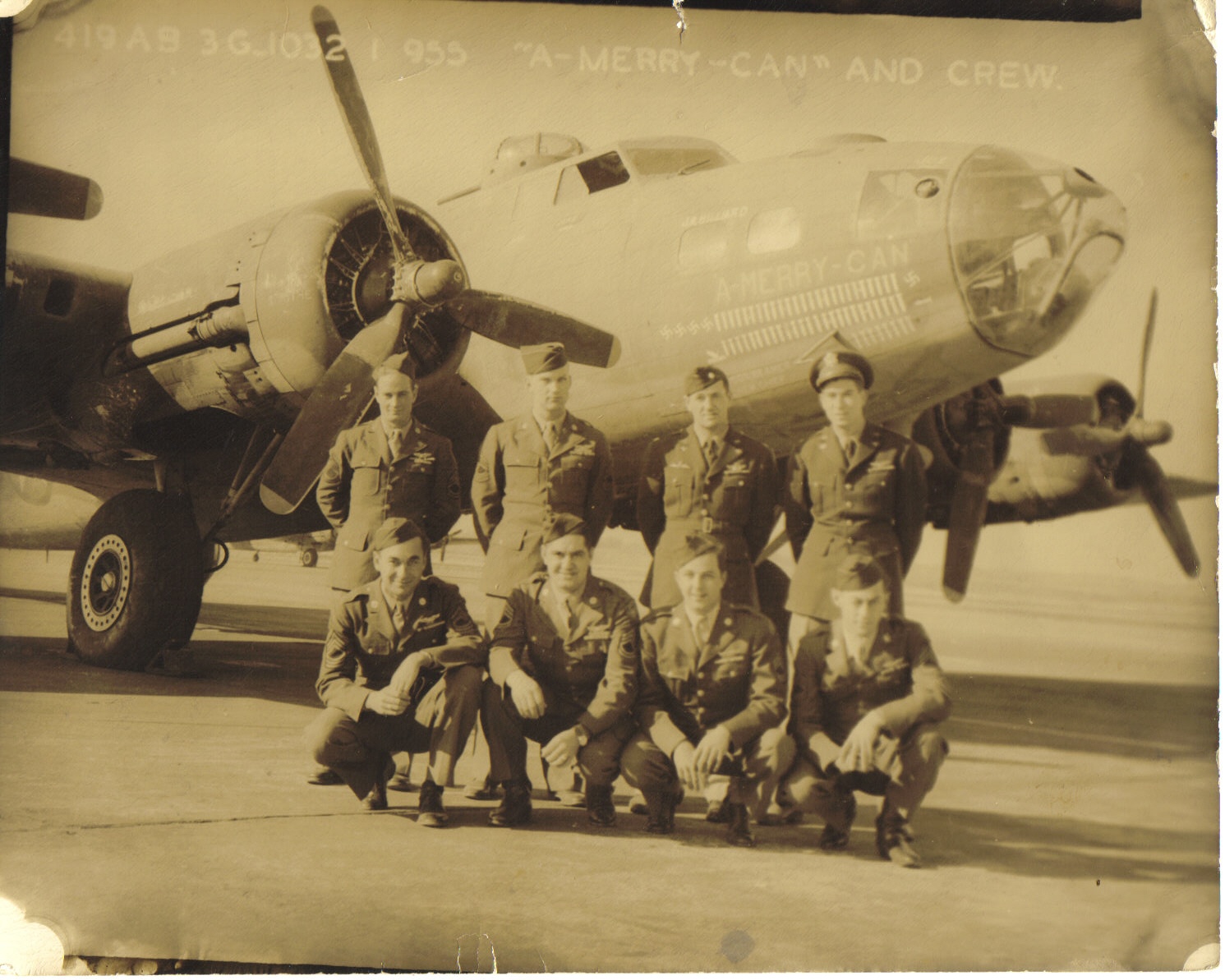
Subject: The Crew of the B-17F "A-Merry-Can" of the 49th Bomb Squadron
Attached below is a photo of A/C 229611 with a partial crew which includes Robert Haynes (pilot), Charles Johnson (engr/top tur), and Louis Gibson (waist gun/radio op), my uncle. Also, the following is an interesting link to an article, "G.I. of the Week" about Charles Johnson in the campus newspaper of John Tarleton College in Stephenville, TX on February 12, 1946.
http://texashistory.unt.edu/ark:/67531/metapth140962/m1/4/
Charles Smith
Posted 3/21/14
Subject: Requesting Information - Identify Unknown 2nd BG Officers
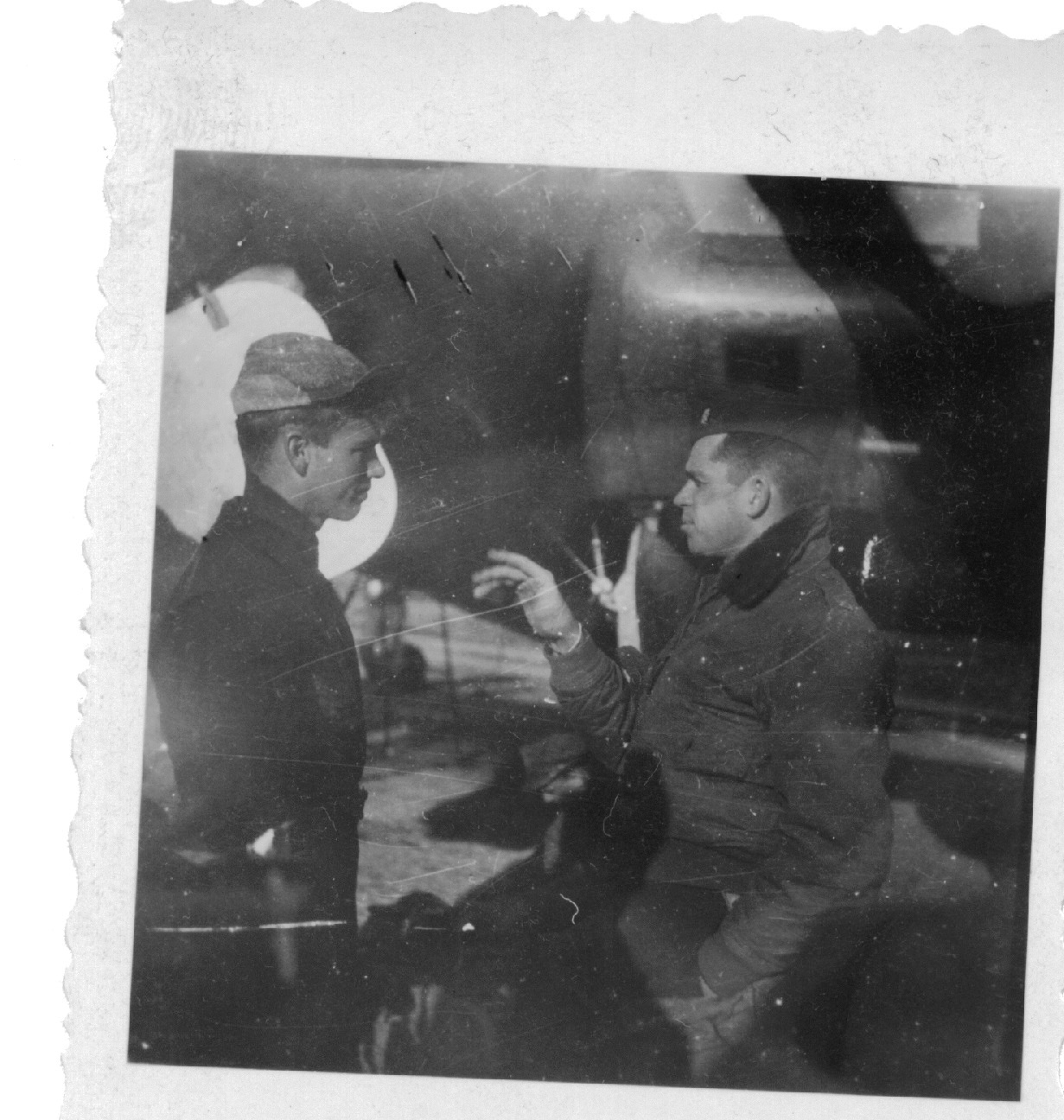
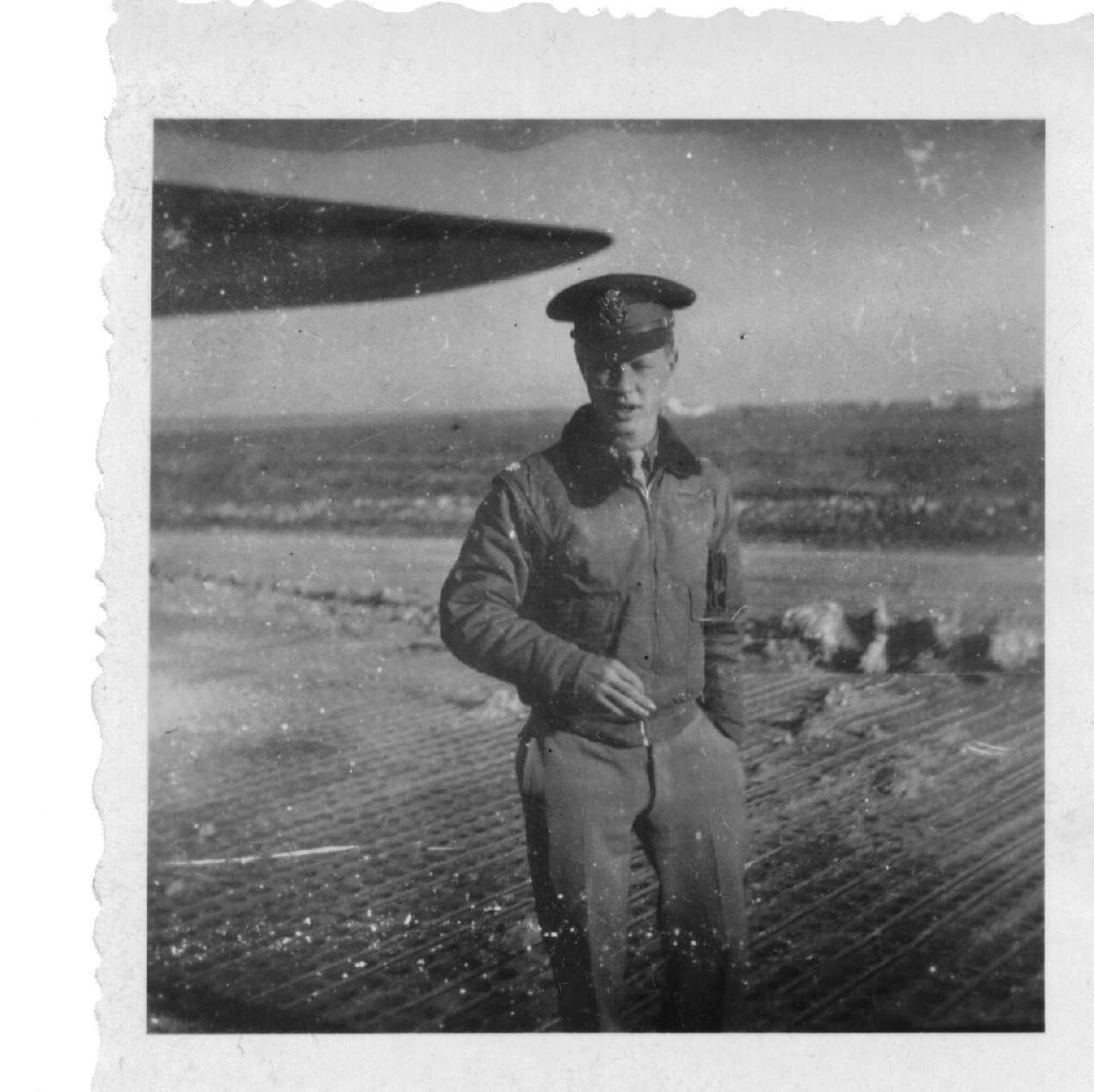
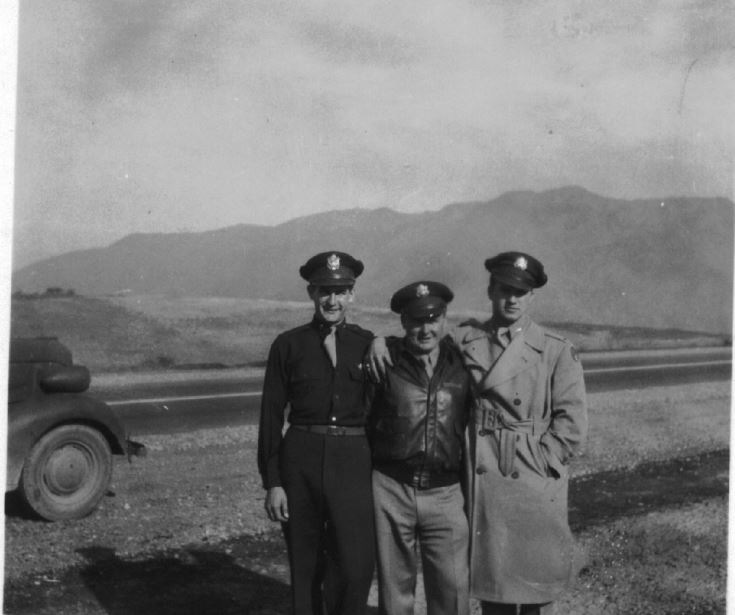
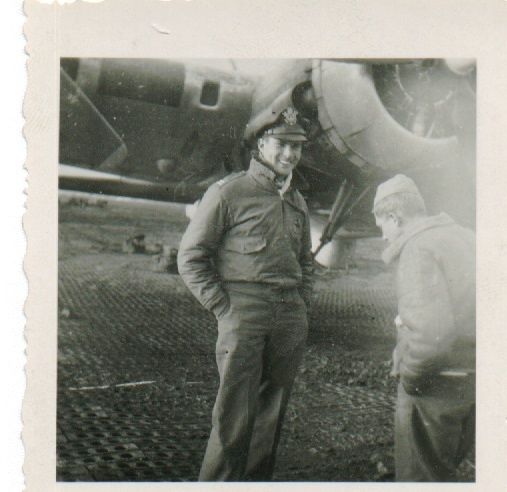
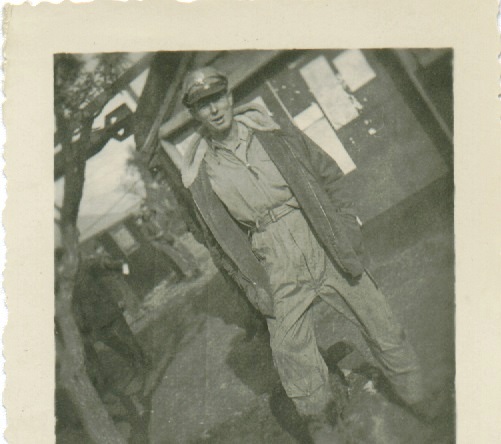
Rob Hofmann, the nephew of Capt Jerry Hofmann who was a pilot in the 429th Bomb Squadron, is requesting assistance in identifying the officers in the photos below. Capt Jerry Hofmann is in the middle of unknown # 4. You can click on each photo to enlarge it. Please contact Robert Hofmann at robertdhofmann@yahoo.com
 |
 |
 |
 |
 |
 |
| Unknown # 1 | Unknown # 2 | Unknown # 3 | Unknown # 4 | Unknown # 5 | Unknown # 6 |
Posted 3/20/15
Prisoners of War - Stalag Luft 1
There is a writeup on http://www.merkki.com/brynerjohn.htm by my grandson, Matthew Bryner, about The Peace Memorial Monument, dedicated 22 March 2005 in Grossraschen, Germany. Thirteen German citizens and my 9 crewmates were killed in the crash of my B-17 #44-6440. We designed a beautiful black marble monument for the old graveyard in Grossraschen. Special Note: The city plans a nice ceremony 22 March 2-15, 70 years after the crash, and all members of the 215th USAAF, friends and relatives are invited to attend. Wolfgang Lehmann, a 16 year old Hitler youth was badly burned in the plane crash: POW in Serbia 1945-1955, returned home with others. I was invted to attend, but at 90, recovering from a heart attack, I regretfully will not be there. For more information, ask Matt Bryner, 2nd BG Assoc Treasurer for me.
Sincerely,
John Bryner
Posted 7/7/14
Subject: Searching for a Copy of the Book, "A Bombardier's Story", by Paul Dolan (20th Bomb Squadron)
My father, Frank C. Hammond, flew with the 5th
Wing, 2nd Bomb Group, 20th Bomb Squadron, 15th Air Force in WWII. He was a
tail gunner on both the B-17F and B-17G out of Amendola, Italy. I have
recently found a book written by a Paul Dolan, titled "A Bombardier's Story"
which I have borrowed from the St.Petersburg, FL library through an
inter-library loan. However, I am interested in purchasing this book but
it is out of print, as well as the Publisher, Florida Hand Prints (Tampa, FL).
I can't seem to track this book down and I was wondering if you might have heard
of it and would know if there were any copies that can be purchased? I
thank you for any information you might have that will help me with my search.
If you need any additional information, please email me?
Sincerely,
Jim Hammond
gabehammond@comcast.net
Posted 7/7/14
Subject: Searching for 96th Bomb Squad Members Who Remember Wilbert Wolken, Ordnance Officer and Adjunct
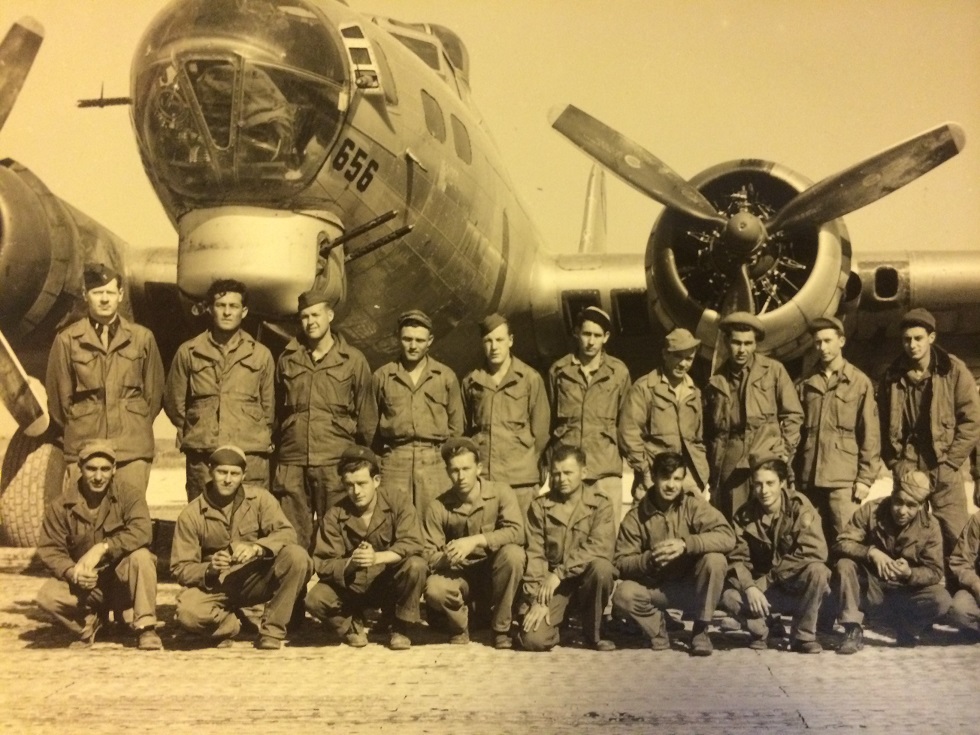
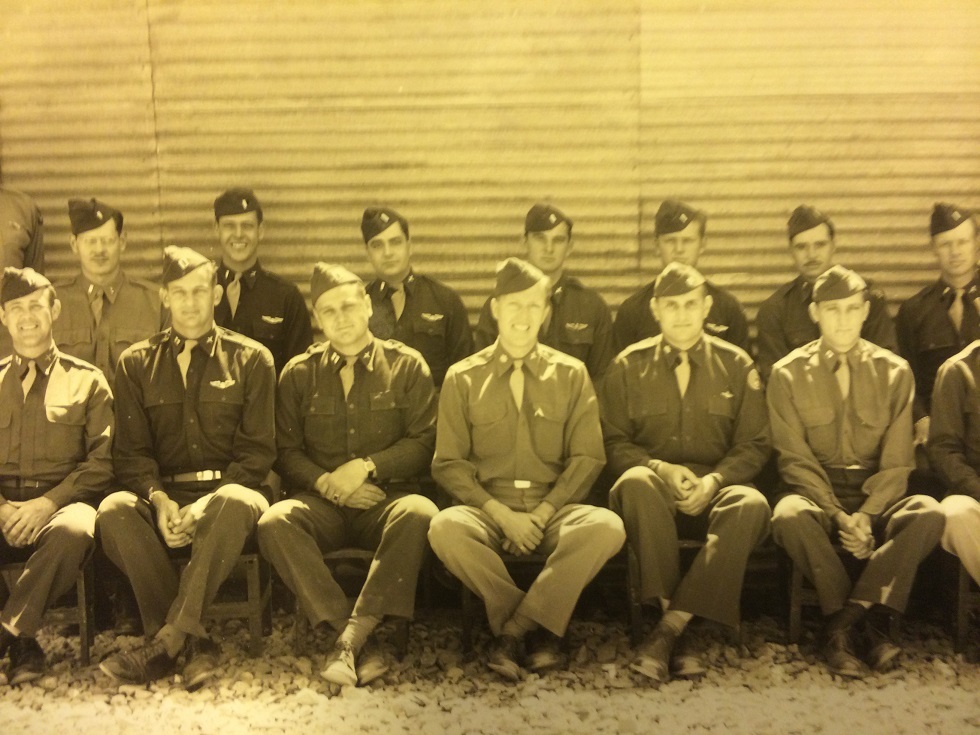
My father, Wilbert
Wolken, was not a flying officer; he was the Ordnance officer and Adjutant for
the Red Devil (96th) squadron, according to letters that he wrote to my mother.
So I was wondering if your database is confined to flying officers and men?
Could there perhaps be another source for non-flying personnel? I
was also wondering if it would be possible to post my father's pictures on your
Website in the off-chance that a former squadron member might remember him?
My father is the officer at the top left row in each picture.
John Johnston
jdjohn03@msn.com
 |
 |
Posted 3/22/14
Subject: Searching For Photo Taken After Mission # 200
On page 227 of the
book "Defenders of Liberty" under the description for "Mission 200", at the end
of the first paragraph for this "Landmark Mission", it says the following:
"After interrogation, pictures were taken of all who participated in the
mission." Does anyone have any information on these photos or have any
ideas where something like this could possibly be found? I would think
these would be beneficial to many people here on the boards (myself in
particular!). I would appreciate any ideas or suggestions anyone might
have regarding this. Thank You for your time and efforts. I come to
this site often.
Best Regards,
Terry Short
Posted 2/3/14
Subject: Requesting Information about Myron R. Brown, a Bombardier with the 2nd Bomb Group and 96th Squadron
I am writing to you
in hopes that within the Second Bomb Group there is some info regarding the
B-17s My Father flew in. My Father was Myron R. Brown, a Bombardier with
the 2nd Bomb Group and 96th Squadron. During his tour he was a Bombardier
on the following Aircraft:
AC# 446443 STARFISH
446116
446655
446395
446677 Take IT EASY
446448 HUBBA BUBBA (Big Nose)
446778
4338483
As far as I can tell, all of these aircraft came back to the USA for salvage.
Some went to Kingman, some to Walnut Ridge, and one to Alburqurque. Any
photos of aircraft and crew members would be so greatly appreciated. I plan to
take my second flight on a B-17 this summer.
Raymond R Brown, FCNS1
317-509-2022
rbrown46140@gmail.com
Posted 3/6/13
Subject: Requesting Information about James Leon Lowe of the 49th Bomb Squadron of the 497th Bomb Group
My dad was stations
in Italy toward the end of the war. He was a tail gunner in a B-17. His Air Base
was close to Foggia, Italy. I just got this site from my sister and trying to
find out more of my father, he never talks about it. He just passed away 2 Jan
2013. My mother has a lot of paperwork and pictures of him after the war in B36
and B52 but not any from Italy. I was hoping to find a picture of him here or
mention of his name (James L. Lowe) on your web site. I’ll keep looking. If you
want a copy of his flight record about the missions let me know and I’ll get
them to you.
Thanks for the web site
Kenneth L. Lowe, Ret MSgt USAF
Posted 2/22/13
Subject: Seeking Information on William D. Leet of 20th BS for Austrian TV Documentary
We are Austrian
Filmmakers, currently preparing a documentary film for TV on a story about the
so called "Foo Fighter" phenomenon. We are looking for members of the
Second Bomb Group stationed in Amendola, Italy in 1944. More precisely we
are looking to contact William D. Leet or his brother Warren R. Leet or anybody
who served with them. For any information you can give me I would be most
grateful.
With kind regards from Vienna, Austria,
Daniel Wunderer -
d.wunderer@blueandgreen.info
Friedrich Moser -
f.moser@blueandgreen.info
Writers & Directors
Posted 2/6/13
Subject: Requesting Information about Lt Col Robert E Haynes of the 497th Bomb Group
Do you have any records or obit on Lt Col Robert E
Haynes of the 497th Bomb Group. Harold Plunkett is trying to find
any information on him from after the war. Trying to help finish a history
request for another WWII veteran. Any leads appreciated.
Regards,
Todd Weiler
2nd Bomb Group Historian
2761 N. 37th St.
Milwaukee, WI 53210
414-688-6401
308m14@gmail.com
Posted 1/25/13
Subject: Requesting Information about Arthur R (Bob) Dixon and/or Sudden Crash of B-17 "Jocko" #42-31682 After Takeoff
I have a long standing interest in the B-17 and the air war in WW II. I
recently had a conversation with a colleague, Donald Dixon, who related the
following:
1). His uncle, Bob Dixon, was a B-17 waist gunner taking off in Italy for a
mission, when his aircraft crashed on takeoff killing everyone on board.
2). Don’s grandfather, Arthur Dixon, told him in the late 1950s or early 1960s
that Uncle Bob’s aircraft was sabotaged; a bomb was rigged in the wheel well of
the B-17 so that when the wheels retracted the bomb detonated. The saboteur was
discovered and executed.
Intrigued by this conversation, I discovered from your web site that the B-17 in
question was probably 42-31682 of the 96 Bomb Squadron, which crashed on takeoff
on 6 December 1944. The only question: The name of the waist gunner was listed
as Arthur R. Dixon. Don and I both conclude that since his father’s name was
Arthur, Uncle Bob may have gone by his middle name as d\Don has confirmed that
his middle name was Robert.
The second point about the saboteur is intriguing. I recently attended the 8th
Air Force Historical Society reunion at San Antonio where the same story
surfaced from a number of surviving veterans. Part of me considers this
saboteur story to be more an urban legend than anything else. However, I do find
it odd that the loss of 42-31682 was never documented either in the form of an
Accident Report or a Missing Air Crew Report. It seems the only mention of the
incident appears in the history The Second Was First.
Here is my question: Is there anyone in the association who might be able to
shed additional light on this event? In particular, is there anyone who may
remember Arthur “Bob” Dixon or can explain why the event was not documented in
an Accident Report or Missing Air Crew Report. As a footnote, there is evidence
that 42-31682 was involved in a “landing incident” on 21 July 1944, the pilot of
record was William Watlock and the aircraft was classified to be seriously
damaged, if not written off completely. The Second Was First does not mention
this incident, though the personnel data base indicates William Watlock flew
42-31682 on 19 July 1944 and Carl Shade flew the aircraft on 20 July 1944.
Finally, the database indicates there were no missions flown by 42-31682 until 6
December 1944. From my other research focused on the 8th AF this would not be
the first B-17 written off, to be returned to service after major repairs (i.e.
42-97880 Little Miss Mischief of the 91 BG having the rear portion of the B-17
replaced after suffering serious flak damage on 15 October 1944 only to return
to combat on 25 November 1944).
Also, is it possible that somewhere in your records, the serial number for
Arthur Dixon is available (so that Don can track down part of his family
history)? I have copied Don on this email, so if you wish you can contact
him directly at djdixon1@cox.net.
Thanking you in advance for your assistance.
Paul M. Andrews
piccadilly864@aol.com
Posted 10//8/12
Subject: Requesting Information about Vernon D. Morrow and Crewmen of B-17 "60-50"
I recently came across the 2nd BG website and it is the best. I am hopeing
you can help me out. I am writting a book about all the men from my hometown of
Hawthorne, NJ who died in WWI - Vietnam. One of the men Vernon D. Morrow flew
with the 96th BS and was KIA on July 14, 1943. I have the MARC report for his
plane so I know what happened to him. Below is a list of the crew:
MISSING AIR CREW REPORT: A/C #42-29583 - “60-50" - 96TH SQUADRON, 2nd Bomb Group
1st Lt. Vincent J. McIntyre, 0-791314, P. (DED)
2nd Lt. Richard M. Bentley, 0-730343, CP. (POW)
2nd Lt. Wayne M. Greathouse, 0-664884, N. (DED)
2nd Lt. Vernon D. Morrow, 0-730605, B. (DED)
S/Sgt. Otis W. Wharton, 37188611, U/T. (POW)
S/Sgt. James D. Kingsland, 12024924, L/T. (POW)
T/Sgt. Jacob M. Hauber 17040777, R/W. (DED)
Sgt. Casimir C. Manka, 33346371, L/W. (DED)
S/Sgt. George H. Tucker, 37175260, T/G (POW)
T/Sgt. Phillip E. Zimmerman, 17034035, R/O. (POW)
Five of the men were POWs and must have survived the war. Here is where I need
your help as Historian:
1. Do you have a crew photo of this crew or a picture of the plane "60-50"?
2. Do you have any idea as to the meaning of the plane's nickname "60-50"?
3. Do you have a picture of the officer club in Italy which was named "60-50"
4. Do you know if the above men listed as POWs are in the BG association and how
I may contact them?
I would really like to talk with any surviving menbers of Morrow's crew. It
would greatly help me write a good story about the his crew, plane and him. I
appreciate any assistance you can give me.
Best Regards,
Paul Chepurko
pchepurko@optonline.net
Posted 6/27/12
Subject: Requesting Information about Willie J. Schonage
I have been searching for information on my father and those he flew with in 1945. ... I had heard stories for years about the plane being damaged and an emergency landing in Russian occupied territory. That was confirmed in the article. There were many stories like this which I unfortunately did not absorb fully as a kid. My father died 20 years ago and now I am trying to get a better understanding of what these men went through. I was hoping to locate other crew members or families of them. Share pictures (of which I have very few) and any stories. I had attempted to get military records but it seems they were destroyed in a fire. The information I found in "The Second was First" is the most I've been able to locate so far. The B-17 AC that made the emergency landing on March 23, 1945 was #682. The crew were as follows:
2nd Lt. Arthur K. Forest, P.
2nd Lt. Libero P. Casaccia, CP
2nd Lt. Walter F. Javor, N.
2nd Lt. Louis Etter, B.
S/Sgt. Hugh W. Sexton, U/T
Cpl. Willie J. Schonage, L/T (This was my father whose name was William J. Sohonage)
Cpl. Hugh A Stenvenson, R/W
S/Sgt. Herbert W. Wendt, L/W
Cpl. Joseph F. Klykamp, T/G
Cpl. Vernon H. Sanders, R/O
Any information would be greatly appreciated!
Thanks,
John Sohonage
johnso@searhc.org
Posted 4/21/12
Subject: Requesting Information about Frank J. Sims
Thank you very much,
Ahron Shapiro
ashapiro@aijac.org.au
Posted 4/18/12
Subject: Requesting Information about S/Sgt. John J. Bradley, Waist Gunner, 20th Bomb Sqdn, KIA 8/18/1944, Mission 254, Ploesti, Ro
Posted 3/27/12
Subject: Need B-17 Photos for Book about Operation Frantic
I'm writing a book about Operation Frantic (shuttle bombing missions that
utilized Russian bases). Would you have, or anyone you may know of have
any original B-17 photos that could be used in the book (originals will be
returned). I know this is a long shot but I figured I would take it
anyway. Seems my Grandfather did not have a lot of photos of aircraft,
mostly men on the ground at Amendola.
Thanks so much, any help would be greatly appreciated.
Best Regards,
Jim Oliveri
Posted 3/17/12
Subject: Searching for Dyersburg AAF Trainees and Photos
Hello 2nd BG,
I am the historian for the Dyersburg Army Air Field, TN. I would like to hear from any members who did their training here from 1943 to 1945. I am especially interested in crew photos taken here or any of the base’s B-17F’s and G’s.
Sincerely,
Tim Bivens
tbivensb17@cableone.net
Posted 3/17/12
Subject: Searching for a Photo of Col. Maurice A. Berry
Dear Sirs,
Could you please let me know whether you keep a picture of Col. Maurice A.
Berry that you could kindly share? He led the mission on March 25, 1945. I
am writing you as a co-author of the book entitled "Praha v Plamenech"
(Prague in Flames) on U.S. air raids against Prague during WWII. We are
working the second, updated edition that is supposed to be published in May
2012. Could you please let me know how many ships flew the mission on March
25, 1945 and how many of them were reported damaged? Are there any details
on this mission in your collection you could kindly share? Thank you for
your assistance in advance.
Kind regards,
Filip
Vojtasek, Prague, Czech Republic
filipvojtasek@gmail.com
Posted 2/21/12
Subject: Staff Sgt Les Potter
The attached photo’s were of my father Staff Sergeant Les Potter who served as radio operator 429th Bomb Squadron, 2nd Bomb Group. He was wonded on his 15th mission over Austria, 25 July 1944. I have very little information regarding my father’s military career and would like to know if any of his fellow squadron members are still alive and if they remember him. Like so many, my father never talked much about his experience. The two pictures are of the aircraft and original crew that my father went through training. There is a note on the back of the aircraft picture saying Montaina 1944. Any information you can provide would mean a lot to me. My dad passed away two months ago. He was proud of his participation in WW II. My phone number is: 818-624-6344 and email is: gpotter@uasc.com
Greg L. Potter
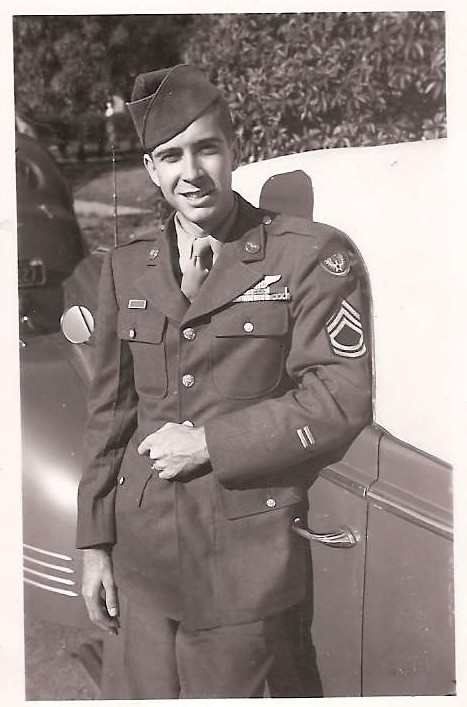
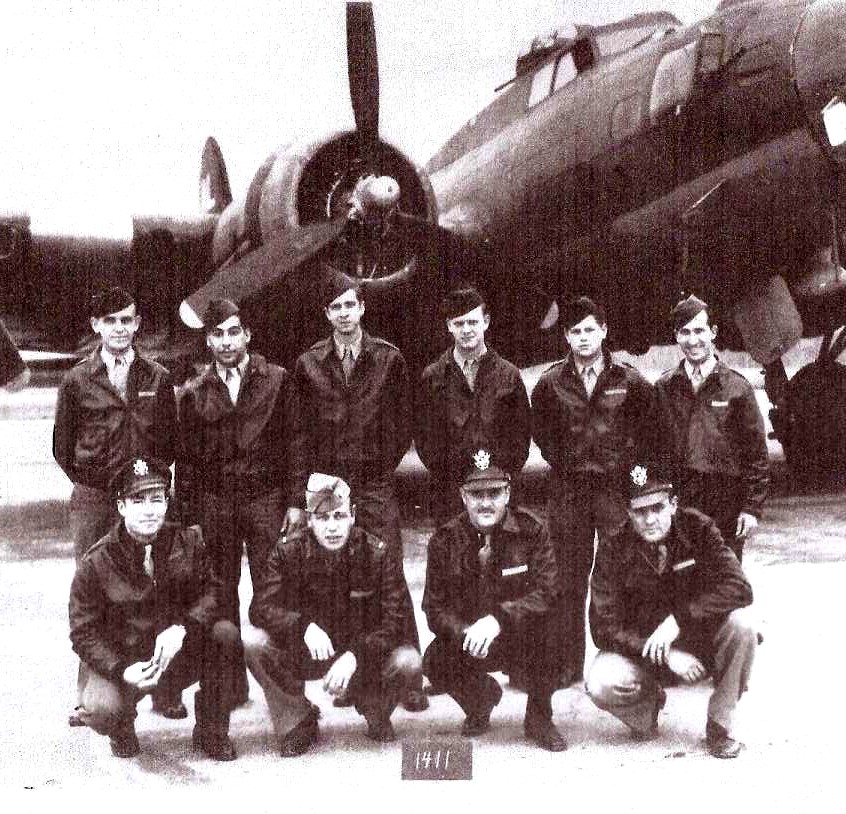
Posted 1/30/12
Subject: Francis A Abbott - Vienna Mission 379 Crash Landing - 15thAF / 2nd BG / 49th BS.- March 16, 1945
I would like to connect with anyone part of the group or had
family within the same group. The details of the crash landing (all made
it back), are nicely detailed on this website:
http://www.2ndbombgroup.org/TheSecondWasFirst.pdf
Printed pages 488 - 491 (PDF pages
500-503). There are two Photo's meant to be in that PDF, that aren't
appearing. I would love to see the photo of my grandfather, the second one
with the
caption: "T/R-L/R - E. Wade, H. Taylor, J. Swift, C. Freeman, Russian Doctor, A. Pierard B/R-L/R - Lisa (Russian Nurse), F. Abbott Courtesy - E. Wade) " Anyone, can reach out to me at david@barbella.com
Thanks very much,
David Barbella
Posted 12/19/11
Subject: Operation Frantic
If it is possible, could a request be posted on the bulletin board? I am
wrapping up a book about Operation Frantic on the 15th Army Air Force, of which
if you recall my Grandfather Tom Ford was a part of. I am looking for any
information, insight, stories, that any members may have. I can be reached by
any of the following, James Oliveri, 21 Danton St. Melville, NY 11747, email at
onenyyankeefan@yahoo.com , or phone
631-423-2014. I would appreciate any assistance. To all members; May you all
have a wonderful holiday season and a very happy new year!
Best Regards,
Jim Oliveri
Posted 12/12/11
Subject: B-17 Aluminum Overcast
I had the great good fortune to fly passenger on
the Aluminum Overcast last June 11th at Centennial Airport near Denver. A young
chap carrying a microphone asked me questions about flying a B-17 in 1944 out of
Amendola, Italy. About a half hour later he ran me down and wanted to know if
I’d like to go up in “AO”.. I readily agreed, signed a waiver, and we were up,
up and away. First time up in one in 67 years. It was fantastic to be sitting in
the Bombardier’s seat and seeing the Denver landscape at about a 1,000 feet. It
was noisier than I remembered.
Bob Fredericks, a WWII pilot in the 2nd Bomb Group, has a great suggestion.
Could we (you) put it up on our web site??!!
Nice closeup pics of a restored B-17. Click on link
http://home.comcast.net/~szee1a/Al_overcast/Al_overcast.html
Sincerely,
Loy Dickinson
Posted 12/11/11
Subject: A Veterans' Day Remembrance
I thought the group would like to read this essay that appeared on the front page of the Chicago Tribune's Perspective section back in 2003 -- exactly 60 years after the letter from my grandmother to my uncle was written. It is reprinted in the Trib Local today. Click this link: Words, War, Worry If you have any trouble with it taking you directly to the article, please email me. I hope you'll share it with the group members.
I'd like to thank you both
and all the brave young men you flew with so long ago for your
dedication and sacrifice in protecting our country and the world in
those perilous times.
BTW, I'm reading Unbroken now by Laura Hillenbrand, author of Seabiscuit. Unbroken is the story of B-24 bombardier, Louis Zamperini and how he survived 47 days at sea and then cruel impresonment in a POW camp before being released in 1943. A compelling story with lots of details about flying the B-24 and the war and era itself. I'm sure the men would be interested to know about this book. Here's the Publisher's Weekly blurb: Hillenbrand's triumph is that in telling Louie's story...she tells the stories of thousands whose suffering has been mostly forgotten. She restores to our collective memory this tale of heroism, cruelty, life, death, joy, suffering, remorselessness, and redemption."
All the best,
Linda Gartz
Posted 8/9/11
Subject: Lawrence Carastro DFC Request
I am trying to find information regarding an incident which occurred when we were on a bombing mission # 134 on January 27, 1944. When the pilot, Lt. Frank Glass, did not receive a response from the Radio Operator/Gunner, Vincent J. Pesature, he asked that one of the Waist Gunners check on him, and I volunteered. I removed my parachute, disconnected my oxygen, ran into the radio room, and reconnected my oxygen. He was slumped over his radio table, and his oxygen indicator was not moving. I turned his oxygen to 100% and he came up. I turned it off and he slumped down again. I tried this three times with the same result. I notified Pilot Glass, and he said we should abort the mission. In the meantime, Top turret gunner, George Hawk, came through the bomb bays and gave me an oxygen mask that he found in the cockpit. I took off the defective mask and replaced it with the other mask. Sgt. Pesature was revived, and we did not have to abort the mission – which would have put the plane in extreme danger. The overhead panel had been removed so that we could point the machine gun outside and the air was extremely cold (below 40 degrees) I had to remove my gloves to help Sgt. Pesature, and after a few minutes my hands began to feel stiff, and turned white and wrinkled, as I was in the slipstream under the overhead panel, and frostbite was setting in. This information needs to be corroborated by someone in authority in order for me to be elegible for the DFC medal. If you can give me any help in obtaining information regarding this incident, it would be greatly appreciated.
Sincerely,
Lawrence Carastro
2948 Eastwind Dr.
Fernandine, Beach, FL 32034-8959
Mr. Carastro is particularly interested in finding 2nd Bomb Group Members who were on the 2008 2nd bomb group roster. (Richard S. Abbey, Ernest Henderson, Arther E. Jobin, John J. O'Donnell, Robert M. Tiffany) Remaining survivors on the plane are Richard B. Paul, Ralph Karsh.
Posted 6/19/11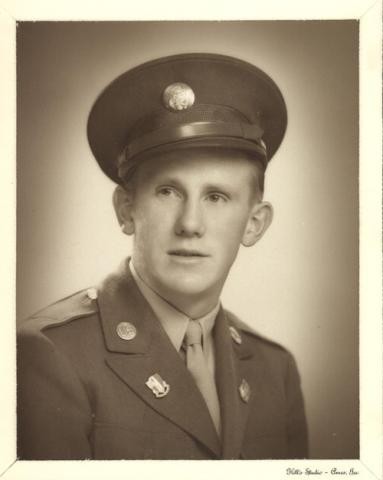
Subject: The Return of Staff Sgt. Marvin J. Steinford, 429th Bomb Squadron, MIA 03-24-45

Posted 4/11/11
Subject: Searching for Fellow Crewmen of Clarence Marvin Hunt, Jr of the 429th BS
My brother was a member of the 429th Squadron, 2nd Bomb Group, 15th Air Force. His name was Clarence Marvin Hunt Jr. He was a tail gunner and flew from June 1944 until about November 1944. If by chance you know the where-abouts of anyone that flew with him please let me know.
Regards , Tommy Hunt,
1115 Donphil Rd. , Durham , N. C. 27712
919-620-7812 / cell 919-215-4936
Posted 1/10/11
Subject: Please Help - Searching for Former Members of 2nd BG Repair Units (mechanics) - Shade of Dark Olive Drab Color
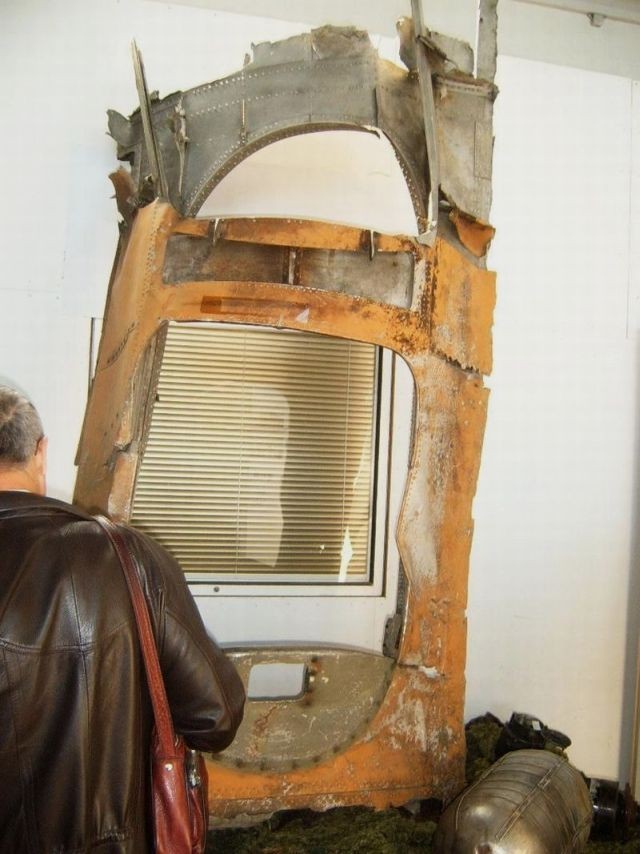
Hello,
Is anyone in touch with a mechanic from a 2nd BG repair unit? There´s a
big discussion on B-17G color (Olive Drab and its totally different shades) on
the Army Air Forces Forum.
http://forum.armyairforces.com/tm.aspx?high=&m=195467&mpage=1#195467 .
I would like to speak to someone who could bring some light on this. An
example of the 'strange' brown color is attached. This part used to be a part of
B-17G, 42-31885, "Lovely Ladies", shot down on Aug 29, 1944. Any ideas about
this color?
Thank you!
Roman Susil
Zlin, Czech Republic
roman.susil@gmail.com
Posted 9/22/10
Subject: Please Help - Searching for Relatives of Sgt. Joe Marinello, Jr. who was Killed on Mission 263
Hello,
I´m looking for relatives of Sgt. Joe Marinello Jr. Joe was killed during the
mission 263 as a ball turret gunner aboard of B-17G, 42-97159 and was buried at
the cemetery in Rudice, Czech Republic and later exhumed in September 1946.
I´m going to see Joe Owsianik (a left waist gunner from the same machine) from
South Plainfield, NJ in October and will spend few days in Brooklyn as well. Joe
Marinello was born in Brooklyn and his father´s last known postal address was
Mr. Joseph Marinello, 1060, 60th St., Brooklyn. I´d really want to meet
some of his relatives and take a picture of his grave. Is there anybody
who would be able to give me some info on his relatives?
Thank you in advance!
Roman Susil
Zlin, Czech Republic
roman.susil@gmail.com
Posted 8/10/10
Subject: Information about 1st Lieutenant Lawrence S. Grennell
I recently discovered the 2nd Bomb Group website, and have found many times more information about my father's history in Italy than I thought was possible. Lawrence Grennell was a Co-pilot/Pilot in the 20th Squadron from late April to late August 1944. I have a list of his missions, crewmembers, and some stories of particular missions. I am very grateful to those who put this together, as it fills a large gap in his life which we (his family), knew little of. He spoke little if anything about those months to his children, and died before he was 51.
I am hoping, that if this Email could be posted, some surviving crewmember, or family member of someone who knew my father, would share with me, any story, photo, or passed down recollection concerning him. His A/C tail number, as a pilot, was 46200, and I have not heard whether it had a name or not. He flew, as a co-pilot with Otto Hanes crew for most of three months, after which most of that crew flew with him as pilot. Some names that keep showing up on his crew lists were W.C. Schmeer, James C. Ingram, Glenn W. Ford, Delbert Milleson, and R.N. Riding. If there is a crew photo out there somewhere, that would be a very important find for me. My E-mail address is: glgrennell@gmail.com .
As a retired Air Force B-52 crew chief, these
things hold great interest to me, and I'd be grateful for any leads.
Thank you!
GLGrennell
Posted 3/6/10
Subject: From Cut Bank, MT - Robert "Bobby" Barlow
bitnspur45@aol.com
Posted 1/31/10
Subject: Research Project Updates
Hello Mr. Weiler and Mr. Waters!
Hope you remember me, it's been a while since we were last in contact. Cali Neuberger from Omaha Central researching 2nd Lieutenant Gerald K. Beem for a senior history project. Just wanted to give you gentlemen an update on how my research is going (swimmingly!). I met with Mr. Beem's youngest brother a few weeks ago and wow - what an amazing experience. He shared a lot of really valuable information with me. I also got a call a few days ago from Mr. Beem's cousin, but I haven't had time to call him back yet. I'm sure he will be a goldmine of information, too. A letter came from a gentleman who shared a great memory of college wrestling with Mr. Beem. I also just today got a photo-copy of an article about the crash from the Great Falls Tribune, dated December 31, 1942 (thanks for that tip, Mr. Waters!). Still waiting on that accident report. Now, here's the information that I would like to pass along to you in hopes that you could help me track down some additional information. Mr. Beem was the co-pilot of the plane. The entire crew was hand-selected to escort Lieutenant Orville A. Ralston home to Valentine, Nebraska. A possible cause of the crash was a lack of oxygen in the cabin of the plane causing the crew to lose consciousness. There was also (possibly) a mysterious 11th member of the crew aboard, in addition to the normal 10 plus Lieutenant Ralston. If anyone could share with me stories about training or being a pilot, that would be helpful! Anything and everything will be welcomed. Thanks both of you so much, and I would be more than happy to send a copy of my final project when I am finished!
Very sincerely,
Cali
cali_jo@cox.net
Posted 9/25/09
Subject: 2nd Bomb Group Over Blechhammer
My name is
Edward Haduch. I live in Kedzierzyn-Kozle, Poland - a small town which now
consists of former German places like Heydebreck, Cosel and Blechhammer. I
am an amateur researcher of the 15th USAAF strikes against Blechhammer and
Odertal. Me and my friends are running a small museum in order to
commemorate the airmen of the 15th USAAF who fought and often died for our
freedom. We do not have a Website now, but hope we will create one in near
future. You can see some photos from our museum here:
http://picasaweb.google.pl/mkcz67/M?feat=directlink&fgl=true&pli=1
http://poland.usembassy.gov/embassy-events/embassy-events-2008/lieutenant-arthur-lindell-memorial-award-5-june-2008.html
We plan to unveil a War Memorial next year, with the names of 135 USAAF Airmen
who have fallen in the vicinity of Blechhammer. There were also flyers
of 2nd Bomb Group among them: 1st Lt William Nabinger 42-38213; 2nd Lt Owen E.
Rice Jr. 42-38213; F/O Ralph T. Mooney 42-38213; 1st Lt Howard Friedman
42-38213; S/Sgt James O. Jarrell 42-38213; S/Sgt Frank R. Bossi 42-38213; S/Sgt
Herb E. Helstrom 42-38213; S/Sgt Charles L. Woods 42-38213; S/Sgt Dwight C.
Wheeler 42-38213; S/Sgt Wesley Frinsco 42-38213; S/Sgt Howard J. Kidney 44-6176;
1st Lt Arnold T. Kwiatkowski 44-6379; 1st Lt Edward C. Buettner 44-6379; 2nd Lt
Fredrick H. Brilliant 44-6379; 2nd Lt David J. Eiseman 44-6379; T/Sgt Richard H.
Ferro 44-6379; S/Sgt James F. Johnston 44-6379; S/Sgt Elton L. Schumann 44-6379;
T/Sgt Robert C. Wolfe 44-6379.
I would appreciate to receive scans of any documents, photos etc, as well as memoirs of surviving veterans of 44-6176 and 44-6379 aircraft. I would also appreciate if you could send me contact information to veterans or their families. We would like to know more about those brave men in order to honor them in the museum and share their stories with people in our community.
Thank you in advance,
Best regards,
Edward Haduch
Posted 9/24/09
Subject: Historian and Writer Wants WW2 Stories
I'm a retired fighter pilot and also a writer and historian. I specialize in aviation history and have had several books produced by such publishers as Random House, Zenith, Casemate, Pacifica and the Naval Institute Press. I'm currently under contract to write a book focused on World War II aerial operations against Germany. I am looking for contact information for American World War II vets who served as airmen (any type of aircraft or crew position) in the fight over Europe. Obviously, I'd like to talk with vets of the 2nd. Further, I'd very much welcome the chance to review unpublished memoirs or stories from those veterans who may have passed on. I cannot pay for material or interviews but will gladly provide participants or contributors a free copy of the finished book upon publication. I'd appreciate any help you might be able to provide.
Best regards,
Jay A. Stout
Posted 8/30/09
Subject: Charles T. Dickson, 96th Sqd, 2nd Bomb Group, !5th AAF, Jan-Jun 1944
Thank you,
Richard Dickson
rdicks@copper.net
Posted 8/3/09
Subject: "Patches" Crew - Thompson, Hughes, Cashore
My name is Josh Thompson, I am a grandson of Robert L Thompson and a Desert Storm vet. My Granddad always said that there were three who survived "Patches" when she was shot down. One of them was Francis X Hughes the other was John W Cashore. I looked at the crew list for the plane and it said that my granddad was the only survivor. I also looked in the personnel database and both are listed as POW. I am also looking for any information on Hughes and Cashore i.e. are they still alive and where they are now? Any Information would be helpful.
Sincerely,
Joshua L Thompson
s-jthompson@sbcglobal.net
Posted 7/2/09
Subject: Mighty By Sacrifice
Thanks,
Loy
 The
Second Bombardment Group -- and, in particular, the 20th Squadron -- is
the subject of an upcoming book being published by the University of
Alabama Press.
The
Second Bombardment Group -- and, in particular, the 20th Squadron -- is
the subject of an upcoming book being published by the University of
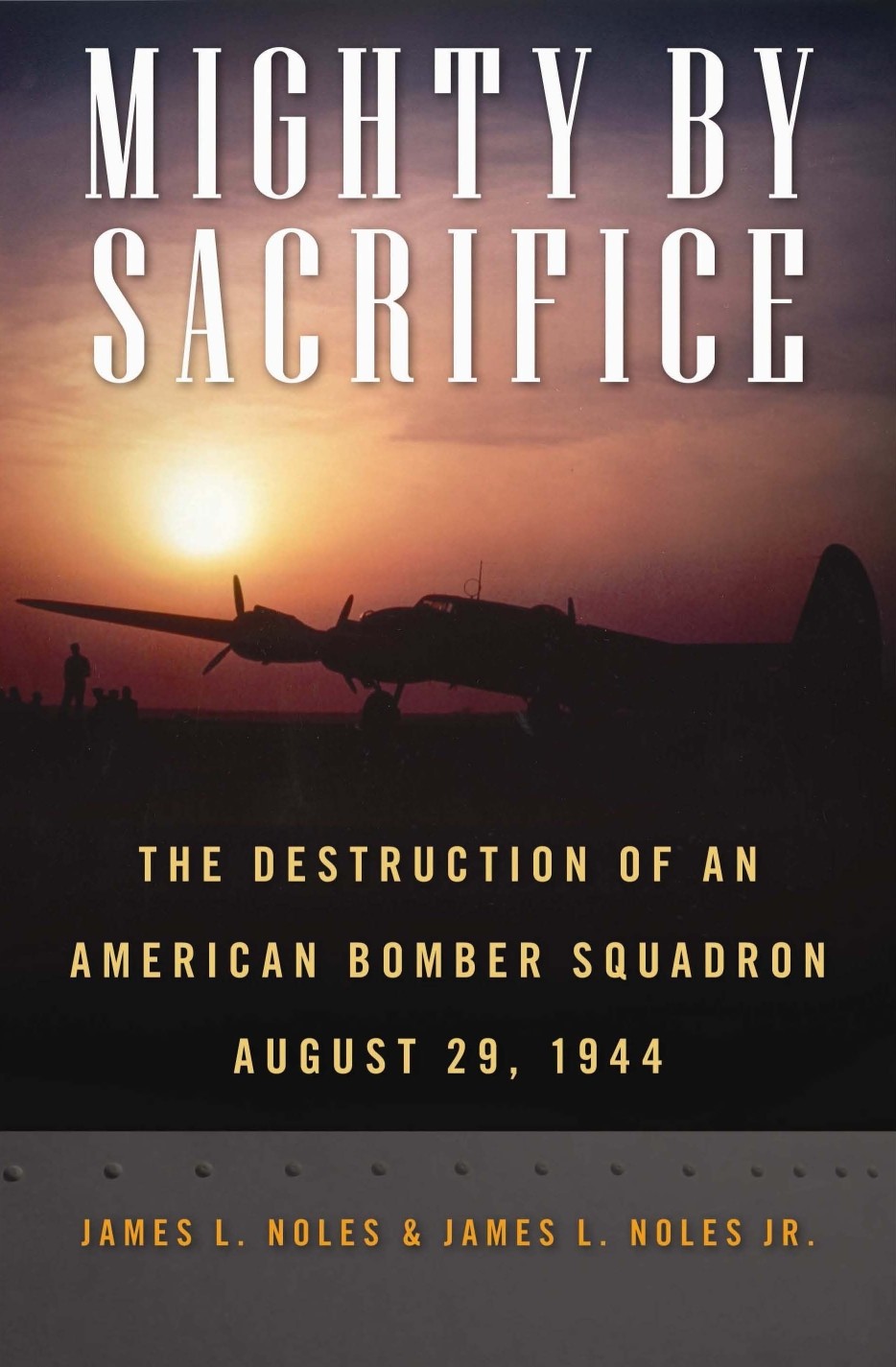
Alabama Press.Mighty by Sacrifice: The Destruction of an American Bomber Squadron, August 29, 1944, is slated to arrive in book stores in late July. It is currently available for on-line
http://www.uapress.ua.edu/NewSearch2.cfm?id=133907
and can also be ordered directly from the University of Alabama Press at 800-621-2736 or 773-702-7000.
The book is authored by James L. Noles, Jr., and his father, James L. Noles. Noles, Jr., is a graduate of the United States Military Academy at West Point and is an attorney in Birmingham, Alabama. He is also the author of last year's A Pocketful of History: Four Hundred Years of American -- One State Quarter at a Time and 2004's Twenty-Three Minutes to Eternity: The Final Voyage of the Escort Carrier USS Liscome Bay (also published by the University of Alabama Press). Noles' co-author and father is a retired Army officer who currently resides in Florence, Alabama.
Posted 6/11/09
Subject: Information Requested on POWs from the 429th BS at Pressburg
I am interested in obtaining information about the following US crewmen of the 2nd Bomb Group, 429th Bomb Squadron who were imprisoned in the Mast POW Center, Pressburg, Hungary.
070245 B-17G 44-6682 429.BS/2.BG 1/Lt Dale E. GOLD
210245 B-17G 44-6689 429.BS/2.BG 1/Lt Eugene F. BULL
210245 B-17G 44-6198 429.BS/2.BG 1/Lt Robert P. TROWBRIDGE
240345 B-17G 44-8162 429.BS/2.BG 2/Lt Richard RAPELYEA
Can anyone please provide me with some additional info (contacts, addresses, memories, narrative reports....) about these crewmen? It would be very helpful with my research. Many thanks for your time!
Sincerely,
Milan Bencek milanbencek@yahoo.com
Horna 265
Liptovska Kokava
SK-032 44
Slovak Republic, Europe
Posted 6/4/09
Subject: 20th Bomb Squadron Crewmen
I am looking for the
following 20th Bomber Crew Members (or relatives) of my Great Uncle Edmund
Nalewak who was killed when their plane was shot down on 13 APR 1944:
LT Elmer Gray
LT James Andrews
LT Robert Kaczmarek
SSGT Milno DeHart
SGT Jack Imhoff (pulled my Uncle body from the belly ball turret after he was
killed in the first passing attack)
These five men I know were POWs. The other crew members did not make it
out. The plane crashed in Papa, Hungary, but my Uncle is buried in an
American Cemetery in France? Thank you.
Regards,
MAJ "H." Shindle (RET) EN USAR
Virginia Beach, Virginia
(757) 412-0877
Posted 5/26/09
Subject: Information Requested about Crash Landing of B-17 #42-29582, 429th Squadron, near Braymer Missouri on 2/19/43
I am researching the crash landing of B-17
#42-29582, 429th Squadron, 2nd Bomb Group, on the morning of 19 February
1943 near Braymer, Missouri. I am hoping to get in contact with crew
members. The crew: 2nd Lt. Douglass L McCarter, 2nd Lt. Raymond T.
Bernier; 2nd Lt. Raymond C. L'Amoreaux; T/Sgt. Robert L. Picking; T/Sgt Sidney A
Cohan; S/Sgt. Clarence P. Morrison; S/Sgt. S/Sgt. Wilbur F. Peterson; S/Sgt.
Hinton M. Waters; S/Sgt. Everett E. Eye. All help will be greatly
appreciated.
William Mackie
wmackie628@aol.com
7306 Shadywood Dr.
Austin, TX 78745
512-447-6763
Posted 4/30/09
Subject: Silver Bracelet Feature Story In Newspaper

Friends,
Attached is a copy of the Silver Bracelet story that ran in today's newspapers, including Burlington, Waterford, Westine, Hales Corners, Franklin and Muskego. If the pictures don't print or the file won't open, be sure to use a newer version of Acrobat Reader available for free from
www.adobe.com. One technical correction I called the reporter on. The 60th anniversary was in 2004, but my visit was in 2007.Enjoy,
Todd Weiler, Historian
2nd Bomb Group
tjweil@pobox.com
Posted 4/20/09
Subject: Searching for Fellow Crew of Frank Ebner Gartz
I’m trying to find other crew members who may have flown with my Uncle Frank Ebner Gartz from January, 1945 – May. He then stayed on in Europe to fly around VIPs who were rebuilding Europe and Middle East. He died of polio, of all things, October 12, 1945. Frank died in Italy on October 12, 1945 from polio in 300th General Hospital in Naples, Italy. He had stayed on in Europe after VE Day to fly VIPs around who were rebuilding Europe after the war. He was a First Lieutenant and navigator on B-17 bombers. He was stationed in Caserta, Italy.
Here are the addresses I have for him for 1945 (based on the return addresses on his letters’ envelopes:
- Feb 16, April 27, 1945 (Post date on envelope), Lt. Frank E. Gartz 0-2071572, 49th Bomb Sq. 2nd Bomb Grp (H), APO 520, c/o PM, New York
- May 29, 1945, 353 Bomb Sq; 301 Bomb Grp, APO same, (Note June 7th when decides to stay in Europe) (letter 137)
- June 16, 1945 (same: June, July & Aug) HQ AAF/MTO Flight Section, APO 650 c/o PM? New York
In particular, his commanding officer, Major David T. Perkins (writing from the Marcianise Air Base on 18 October 1945) , notes to Frank’s mother (my grandmother) the names of two Servicemen who were “Frank’s most intimate friends who are still in the Squadron” and encourages her to write them for more information about Frank (in a letter expressing his sorrow over Frank’s death). Those men are:
Lt. Jack M. Collingsworth, 0-714880 and F/O Stuart H. Heyser, T-5857, 4th T.C. Sq., 62nd T.C. Gp., APO 528 c/o Postmaster, NY, NY.
I am the next of kin as all my father and grandparents are all dead. I also have letters and addresses during all of his training from January 1943 – December, 1945. If I wanted to find some of the men he trained with, is that something I could do through you as well or are there other sites. Before I muddy the waters with information you can’t use, let me know the best way to find buddies from training (e.g., I have the entire list of young men who graduated from the following: 1943, 97th C.T.D. (College Training Detachment, Central State Teachers College) Sept. 18, 27, May 27, 1944, 9/5 FEG 36727093, MTS #2 C.T.D., Stevens Point, WI. He was also stationed in Hondo, TX, Santa Ana, CA, Biloxi, MS., Miami FL. I have those addresses, if there’s a way to find the guys who were there with him.
Thank you for whatever help you can provide.
Sincerely,
Linda Gartz
Email: lindagartz@gmail.com
Phone: 847-328-5647 (answering machine)
Cell phone: 847-757-1382
Address: 2825 Lincoln Street
Evanston, Illinois 60201
Posted 4/14/09
Subject: The Named B-17s of the 5th Bomb Wing (2nd, 97th, 99th, 301st, 463rd, and 483rd Bomb Groups)
----------------------
From: Upchurch, Marty [
mailto:Marty_Upchurch@efiglobal.com]Sent: Tuesday, April 14, 2009 8:25 PM
To: Todd Weiler
Subject: RE: Photos of 2nd, 99th BG Planes
Attached is a spreadsheet of named planes from the 5th Wing. I have sent an e-mail to Jon Forman, whose father had published the B-17 Nose Art Name Directory. His father passed away several years ago and Jon now has his father's photo collection. I am hoping he will send me scans of the planes that were attached to the 99th, and if he is agreeable, I will see about getting copies of the other 5th Wing photos in his collection. If any of you happen to have or run across any photos of 99th BG planes, or other 5th Wing planes, I would love to have copies of whatever you are willing to share. Also, if any of you would like copies of any of the photos I have listed, just let me know.
Thanks,
Marty Upchurch

Posted 1/3/09
Subject: Information Requested from the Daughter of Corporal Lynn B. McCary of 49th Bomb Sqdn
My dad gave me his
Air Force info and I started doing some research and came across your website.
My dad was Corporal Lynn B. McCary, 49th Squadron, 2nd Bomb Group, 15th Air
Corps. His lives in Corsicana, Texas. I am his youngest daughter and
would love to hear from anyone about his missions or any information I can get.
My name is Gale McCary Evers and I live in Tyler, Texas. My email is
jgevers@sbcglobal.net or gale.evers@tylerisd.org
Thanks for your help,
Gale Evers
Posted 1/3/09
Subject: Information Needed - Search for Family of 2nd Lt William A Slaughter from the Daughter of Capt William Disbrow of 20th Bomb Sqdn
My Dad, William Disbrow, now deceased, was a Captain of the 20th Bomb Squadron, 2nd Bomb Group WWII. He has kept in his desk a black & white photo of a stone pile / low wall with a piece of wood with white hand lettering (I suspect it was my Dad's lettering) with the inscription:
Effects of
2nd Lt. William A. Slaughter 0-68032 (then another number or letter that is not
legible)
20th Bomb Sqdn, 2nd Bomb Group
APO 520 c/o Postmaster
New York. N.Y.
M.I.A. 20 December 1943
I would like to give this photo to Mr Slaughter's family and am hoping you might suggest the best way to locate them.
Regards,
Debbie Disbrow
Vice President, Corporate Marketing and Communications, Roundbox
25 Hanover Road
Bldg. A, Suite 101
Florham Park, NJ 07932
T: +1 973.210.8620
F: +1 973.966.0737
www.roundbox.com
Posted 11/10/08
Subject: Cessna UC-78 Restored in 429th Bomb Squadron Split-Arrow Markings of the 2nd Bomb Group
Hi Sid....I thought you might enjoy this picture of the Cessna UC-78 that I am restoring. I painted it in the squadron markings of the 429th in which my father, Terrence M. Sullivan served in WWII. Check out my web site of my restoration project www.cessnat50.org. I plan to fly it sometime early 2009.
253 North Common Street
Shreveport, LA 71101
318-227-8101
Posted 11/10/08
Subject: Veterans History Project Interview of Francis W. Flynn
Hello My Friends,
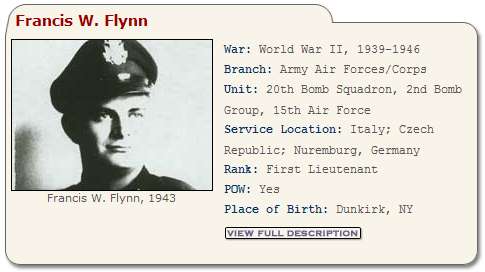
I really don't know if I sent you this interview before, It's a 64 minute-long interview with Francis W. Flynn. So if you haven't seen it yet, go to http://lcweb2.loc.gov/diglib/vhp/story/loc.natlib.afc2001001.02409/ and click on "complete interview".
Bye,
Roman

Posted 11/10/08
Subject: Richard E. Dunkleberger - wherabouts of Rice, Hartsfield, Stephenson, Suratt, and Lane ?
Noted your reunion notice in my latest issue of MOAA. Though I did not belong to the 2nd Bomb Group, my cousin Richard E. Dunkleberger was a member of the 2nd Bomb Group, 20th Bomb Squadron operating out of Amendola, Italy during WWII. He was co-pilot of a B-17, piloted by McKenzie. Their B-17 was jumped by a swarm of German fighters and the aircraft went down. Richard was KIA on his 5th mission over Brux, Czechoslovakia on July 21, 1944.
I have received most all the details I need from the Pentagon under the Freedom of Information Act. These documents indicate five of the crew (McKenzie, Dunkleberger, Rapley, Wickland and Lane) were KIA. There were five surviving crew members; Rice, Hartsfield, Stephenson, Suratt and Lane. They were subsequently captured and interred as POW's until the end of the war.
My purpose in writing is a request to post my e-mail on your bulletin board at the reunion. Perhaps some of the surviving members of this aircraft (# 789) are still with us. Or perhaps there may be an attendee at the reunion who may recall my cousin and can relate some anecdotal information to me.
Richard was my idol at the time and a great influence on my future career. I went on to join the Air Force in 1955, became a pilot and retired with the rank of Colonel after 25 years service, 6,500 hours.
Even if this request hits a dead end, I would like to offer my heartfelt gratitude to all the brave men & women who served in that great war & saved the world. I salute the 15th Air Force, 2nd Bomb Group. God Bless and have a great reunion!
Sincerely,
Eugene (Gene) C. Kennedy
Colonel, USAF Ret.
4811 N. Hidden Terrace
Litchfield Park, AZ 85340
Posted 11/10/08
Subject: Crew of Tuff Titty
Please post on bulletin board. Looking for photos of crew and A/C # 46374, "Tuff Titty".
Thanks,
Jack Lopez
Posted 11/10/08
Subject: Richard Kuhn, Julius Levine, and Ed Mroz
I am researching a scholarly history of the Medical Services Branch WWII
Office of Strategic Services. My book will discuss at length the
activities of Dr. Richard Kuhn, Dr. Julius Levine, and Edmund Mroz. Kuhn,
Levine, and Mroz all served in the 96th Bombardment Squadron 1943-late 1944.
Kuhn an Mroz were later assigned to OSS in the Mediterranean Theater. I am
emailing you in the hopes that you can put out an inquiry on your message board
if any 96th veterans or their surviving family members have any recollections or
photos of Dr. Kuhn and Ed Mroz. I was fortunate to speak at length with
Richard Kuhn before he died in 20404 and some of his recollections are included
in Charles Richards book "Second Was First." I was hoping to find any
other crew members from the Air Crew Rescue Mission No 267 to Bucharest Rumania
on September 3, 1944, or anyone who might have a photo of Kuhn, Levine, or Ed
Mroz that I might be able to use in my book. Kuhn was also a flght surgeon
on missions 121, 197, and 252. Any help you can provided would be greatly
appreciated.
Sincerely, Jonathan D. Clemente, MD
jonathan_clemente@yahoo.com
Posted 10/31/08
Subject: 2nd Bomb Group; 429th Sq.; March 22, 1945; Mission # 383; MACR # 13245, B-17 #44-6697
2nd Bomb Group; 429th Sq.; March 22, 1945; Mission # 383; MACR # 13245, B-17 #44-6697
|
Rank |
Name |
Position |
Serial # |
Fate |
|
1LT |
John W. Pierik |
Pilot |
O-731101 |
KIA |
|
2LT |
Robert W. Steele |
CP |
O-785002 |
KIA |
|
2LT |
John P. Yatsko |
BOM |
O-929489 |
KIA |
|
1LT |
Harold A. Taylor |
NAV |
O-669140 |
KIA |
|
T/SGT |
Richard H. Benjamin |
TT |
37566405 |
POW |
|
T/SGT |
Raymond J. Levesque |
R/O |
31309769 |
POW |
|
S/SGT |
Tony Zevenbergen, Jr. |
RW |
38387823 |
POW |
|
S/SGT |
Wilbur W. Jaffke |
TG |
33670805 |
POW |
|
S/SGT |
Charles R. Redford |
LW |
39920100 |
POW |
|
S/SGT |
Vernon T. Burger |
BT |
39216824 |
POW |
Posted 8/22/08
Subject: Timeless Voices Kit - B-17 Vets
Hi Sid,
Can we uplaod this to 2nd Bomb Group site? Great resource for those
wanting to preserve the legacy of the vets.

Thanks,
Todd
----------
Subject: RE: B-17 Vets Washington DC
Date: Fri, 22 Aug 2008 10:58:14 -0500
From: "Zachary Baughman" <zbaughman@eaa.org>
To: "Todd Weiler" 308M14@gmail.com
Hi Todd,
I copied you in on the email I sent to two of my volunteers on the east coast - Dave Lande lives very close to DC, and Mel Smith is only a few hours away in Charleston, SC. Hopefully one or the other will be available. Attached is the project kit paperwork in Word format. The only thing your or any other interview would need to be concerned with is the Interviewer and Interviewee Release Forms, the Biographical Data Forms, and the list of sample questions. The rest is all supplemental really.
A couple of key points to remember - a quiet, well-lighted room is a must, focus the camera in on the person's head, shoulders, and upper chest, and remember to let them do the talking after asking a question - do not interrupt until they have completed their thought. If you think of something to ask as they are talking, wait until they pause or finish, then say something like, "Can we go back to..." The most common mistake for a new interviewer is to interrupt with another question.
If you have any questions after reading it over, please don't hesitate to ask. I had really hoped to be able to attend the reunion myself, but I am unfortunately swamped with post-convention work that needs to get done asap, and the reunion wasn't even in my line of sight if you know what I mean. IF an arrangement can be worked out to hold the 2009 reunion in Oshkosh or nearby, we could really be able to record a number of interviews in a very short time. Hopefully it will work out. See you at EAA AirVenture Oshkosh-July 27-August 2, 2009
All the best,
Zachary Baughman, EAA #656015
Timeless Voices Program Coordinator &
AirVenture Museum Collections Assistant
EAA-The Spirit of Aviation
Phone: 920.426.6839
Fax: 920.426.6765
-----Original Message-----
From: Todd Weiler [mailto:308M14@gmail.com]
Sent: Friday, August 22, 2008 10:30 AM
To: Zachary Baughman
Cc: Nelson, Karen; Dickinson, Loy; Sid Underwood Web 2nd Bomb; Waters, Lew
Subject: B-17 Vets Washington DC
Zach,
The 2nd Bomb Group Reunion will be meeting at the Hilton Alexandria Mark Center, 5000 Seminary Road, Alexandria, Virginia 22311 Tel: 1-703-845-1010, Fax: 1-703-845-7662. I will be in Washington on August 27th at about 11:00 AM and at the hotel by Noon if all goes well. If you have a "Timeless Voices" EAA volunteer contact me, I will try and make arrangements to have an area and time set aside to videotape the vets. I look forward to receiving your kit for the project. Sorry I missed you at the 2008 Airventure. Perhaps 2009!
Thanks,
Todd Weiler
2nd Bomb Group Assistant Historian
Posted 8/8/08
Subject: Crew of the Ready Teddy
Mrs. Hellums,
I sure have enjoyed reading and seeing the pictures of the 2nd Bomb Group web site. My father (now deceased) was S/Sgt Carl W. Kepper, a tail gunner assigned to the 96th Bomb Squadron out of Foggia, Italy. Dad and his crew departed the United States on the B-17G Flying Fortress "Ready Teddy" but after much research I have found that he and his crew flew most of their missions on AC # 46448. The name of their plane was "Hubba Bubba / Big Nose". I would appreciate you posting the attached pictures to your 2nd Bomb Group website in memory of my father and his crew.
Sincerely,
Karl V. Kepper
SFC, US Army (Ret)
tail-gunner@comcast.net
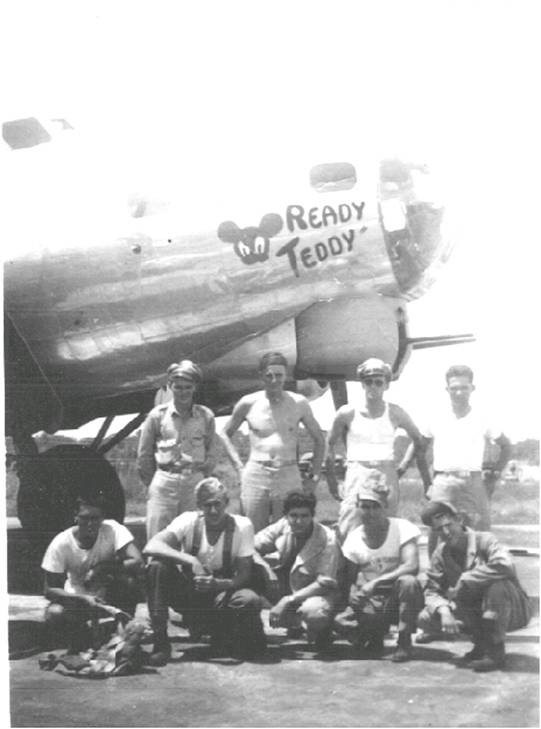 |
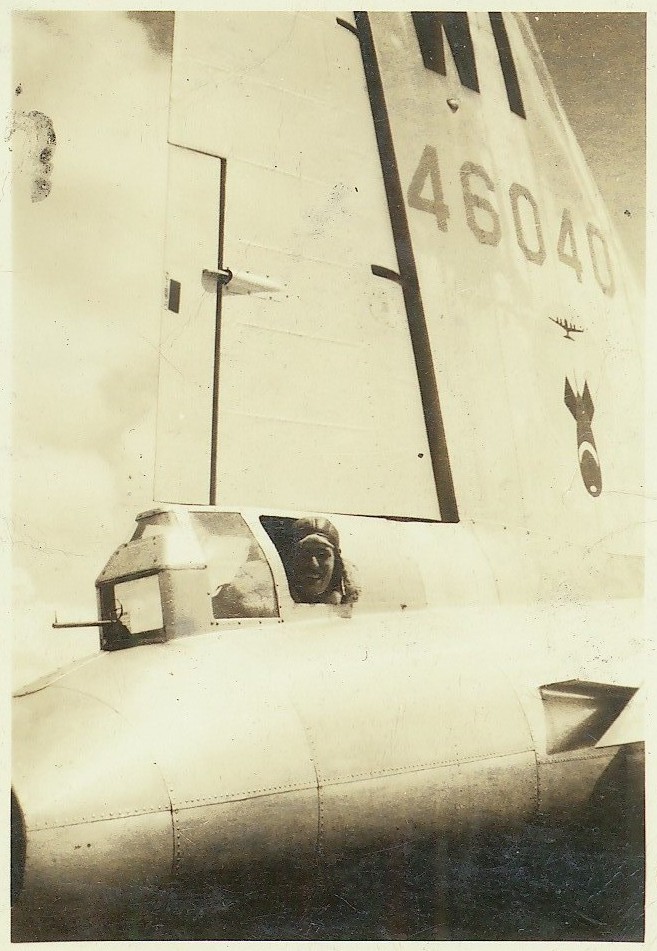 |
(left to right) CPL. Mark Swirsky
(radio operator), CPL. Carl W. Kepper (tail gunner), SGT. Martin
Goziker (Engineer top turret) , CPL. Ellis E. Replogle (ball
turret), CPL. Calvin M. Poorman (waist gunner). Standing (left
to right) 2nd LT. Benjamin “Dude” W. Doddridge
(pilot/commander), 2nd LT. Carl R. Buehner (Co-pilot), 2nd LT.
James Ellerstien (bombardier), 2nd LT. Herman Dooha (Navigator)
|
S/Sgt. Carl W. Kepper (tail gunner) |
Posted 7/14/08
Subject: 2nd Bomb Group History, 96th Squadron
Here is the first installment of historical info that was in the cache that Glantzberg & I took to Barksdale last month. In this instance he has cleaned up an article that was in the collection. Previously, he has sent me a cd with PA infomation on Armed Forces Day in Savannah Gerogia in May 1951. Hunter AFB was to be the headquarters of the 2nd Bomb Wing until 1963. The 2nd Bomb Group became the 2nd Bomb Wing on February 10, 1951. I will send this on to you Sid.
All the best,
------------------
From: Hughes GlantzbergSent: Saturday, July 12, 2008 12:01 PM
To: Buck Rigg; Loy Dickinson
Subject: 2nd Bomb Group History, 96th
I've been working on some of the history of the 2nd Bomb Group and have just completed the attached. I couldn't keep it any longer as I'm sure you'll find it interesting. I may make some editorial changes to it before I'm done, but it's great to read about the 96th back with the 2nd Bomb Group was first activated.
Hughes Glantzberg
Posted 7/8/08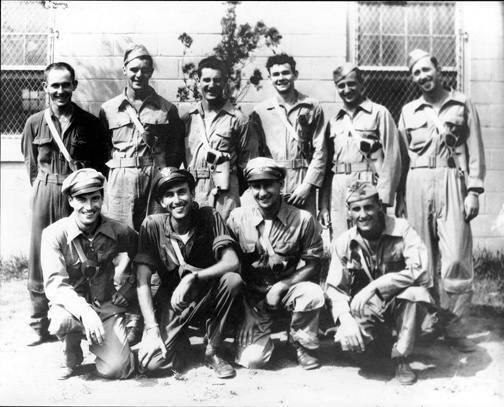
Subject: James Weiler Crew Photo
Sid,
Did I ever send you the James A. Weiler Crew photo to put on the web site? I never thought to ask. We now believe it is Savanah, GA not Drew Field, Tampa, FLA.
We are looking for the names of the others in the picture. Thought perhaps somebody may know their names if on the web site.
Thanks,
Todd Weiler [308M14@gmail.com]
Posted 7/2/08
Subject: Prentice´s B-17 Had A 20 mm Cannon Onboard, Probably In Tail !!!!
Hello my friends,
at least one of 8 B-17´s shot down on August 29, 1944 in our area had a 20 mm
cannon onboard!
B-17G, serial # 42-31885,MACR8099, crash site Vyskovec.
A friend of mine found 20 mm shells at the crash site last year, then we noted a
strange gun on the historical picture (attached) and this week I've found out
this cannon still exist (pic attached, taken from
Fragmenty z B-17G – Detektor web.cz detektory kovù!!!
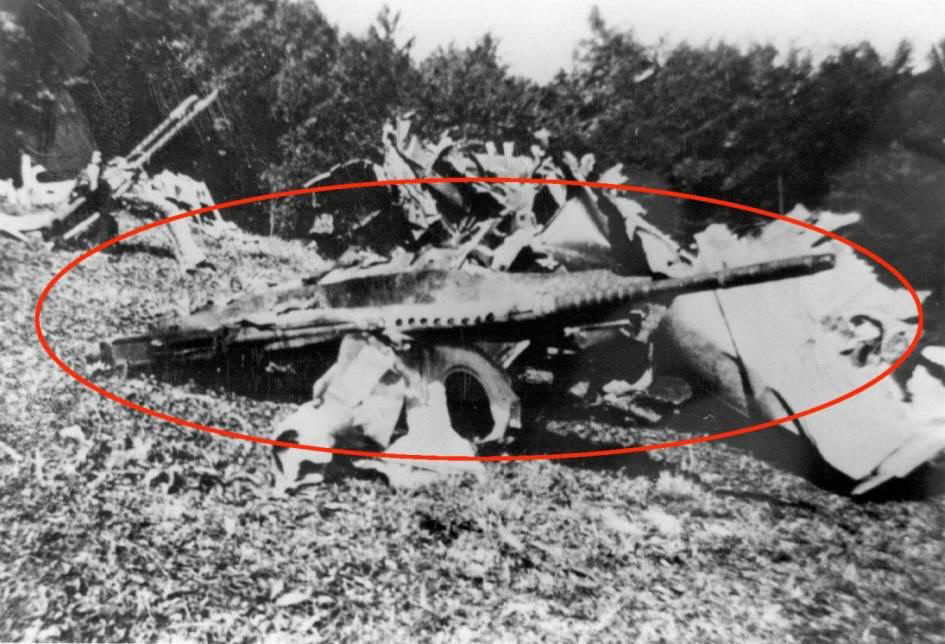
More at
20 mm
cannon aboard a B-17G???
Very rare mounting and very rare pics!
Roman
Posted 5/9/08
Subject: Richard E. Dunkleberger, 20th Sqdn, who was KIA on 5th mission over Brux, Cz on July 21, 1944
Noted your reunion notice in my latest issue of MOAA. Though I did not belong to the 2nd Bomb Group, my cousin Richard E. Dunkleberger was a member of the 2nd Bomb Group, 20th Bomb Squadron operating out of Amendola, Italy during WWII. He was co-pilot of a B-17, piloted by McKenzie. Their B-17 was jumped by a swarm of German fighters and the aircraft went down. Richard was KIA on his 5th mission over Brux, Czechoslovakia on July 21, 1944.
Posted 3/11/08
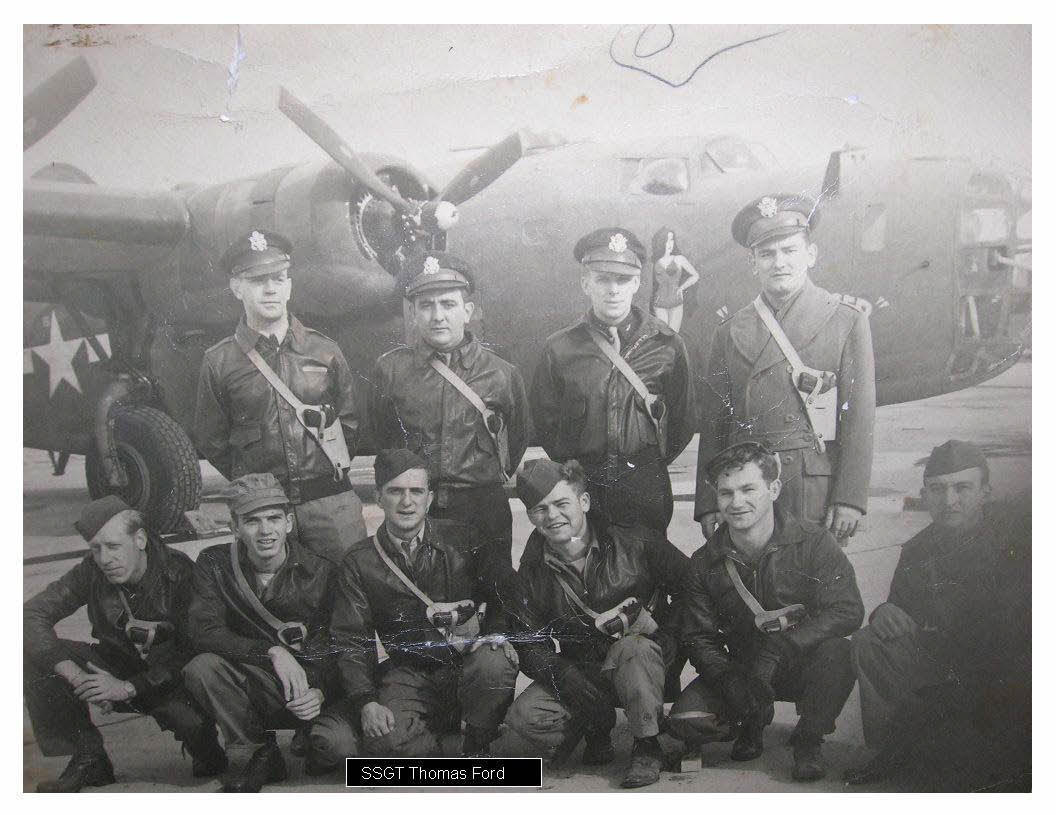
Subject: My Grandfather, Thomas R. Ford
Dear Sir,
I am a recent member of the Association and I wrote a short story about my Grandfather whom I am very proud of. I recently honored him by flying in a B-17. Please accept this letter and photo for consideration on the web site.
Thank You,
Jim Oliveri
Staff Sergeant Thomas R. Ford
was a B-17 tail gunner in the 15th Air Force, 96th Bomb Squadron, 2nd Bomb Group. He flew missions from March 15, 1944 to July 20, 1944. These missions included Cassino, It, Ploesti, RO, Munich, GE, Memmingen, GE, Debrecen, HU, and many more. Some of his aircraft were named “Catherine the Great”, “Dark Eyes”, “Old Bird”, and “Silver Streak”. Thomas Ford was my Grandfather.
 I
was born 23 years after the end of WWII, but I was fortunate enough to hear
first hand accounts from Pop on a regular basis. I can not remember a single
time when I was in his presence that he did not speak of his beloved B-17 or
those .50 caliber machine guns. It amazes me when I think of this considering I
had heard stories about him having a rough time after his service. I know he
spent some time in a Veterans Hospital and there are stories of him waking up
crying some nights and other nights flicking the light switch on and off in his
sleep as if to be dropping the bombs. Somehow he turned a corner and was able to
speak proudly about WWII and his service, and speak he did.
I
was born 23 years after the end of WWII, but I was fortunate enough to hear
first hand accounts from Pop on a regular basis. I can not remember a single
time when I was in his presence that he did not speak of his beloved B-17 or
those .50 caliber machine guns. It amazes me when I think of this considering I
had heard stories about him having a rough time after his service. I know he
spent some time in a Veterans Hospital and there are stories of him waking up
crying some nights and other nights flicking the light switch on and off in his
sleep as if to be dropping the bombs. Somehow he turned a corner and was able to
speak proudly about WWII and his service, and speak he did.
Pop made the local paper during the War in an article that read “25 from Long Island made historic mission from Italy to Russia”. This was the first shuttle bombing raid over Nazi Europe utilizing an air base in Russia. He saved the clipping all those years and we found it in a drawer after he was gone.
Pop passed away on October 26, 1996. Just 2 months prior to his death he was awarded the Commemorative Medal, “The 50th Anniversary of the Great Patriotic War” (World War II). This was issued by Russian President Boris Yeltsin. I can remember that time and how excited he was. He was invited to Russia to accept the award in person. Unfortunately Pop was unable to attend as he did not have a passport and could not have one issued in time.
On May 27, 2006 I took a flight in Pops honor on the B-17 Yankee Lady at the American Airpower Museum in Farmingdale, NY. It was a gift from my wife for my first Fathers Day. In my pockets I carried a photo of Pop with one of his crews, his air medal, a bomb safety pin, and one of his dog tags. It was an incredible experience and left me wishing he was there with me. I guess in a way part of him was there. You see, my wife and I both have brown eyes but our daughter Grace has blue eyes. They say for her to have blue eyes it had to be on both sides of the family. Pop was the only one on my side with blue eyes. Grace was only 3 months old at the time of my flight but she was at the AAM watching it through those bright blue eyes. Maybe, just maybe, Pop was watching through them too.
James Oliveri
Long Island, NY
Posted 3/5/08
Subject: Joe Owsianik Meets Former Enemy Fighter Pilot Willi Reschke
|
Todd and Loy, (you must create an account to access)
Thanks, Zlin, Czech Republic
|
Reschke (left) & Owsianik (right) |
|
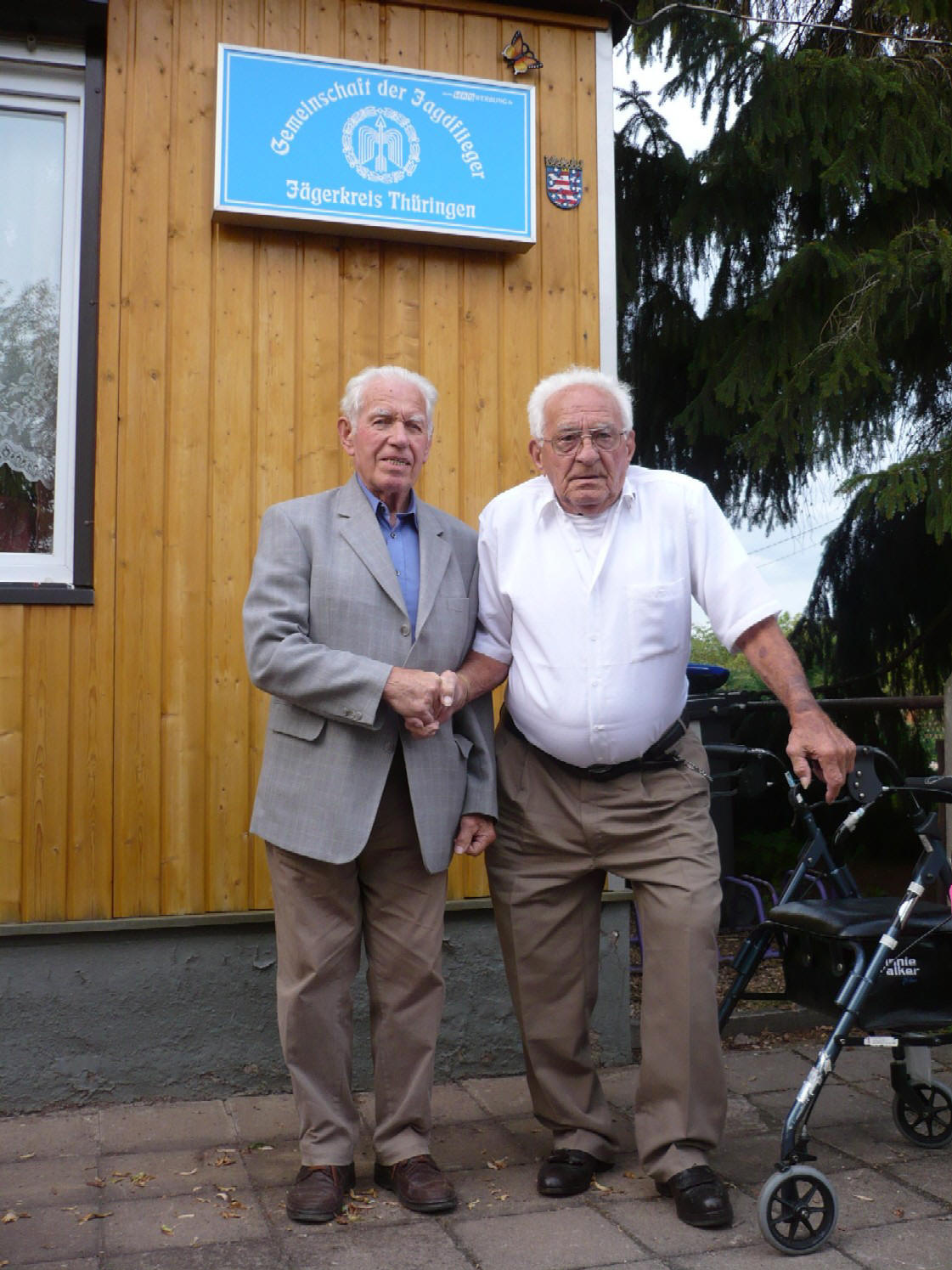
Willi Reschke & Joe Owsianik -meeting after 63 years
Hello flyboys,
I temporary have my American friends on visit here- Joseph P. Owsianik, a former left waist gunner from a B-17G, ser. # 42-97159, "Tail End Charlie" and his grand son Nic Mevoli. This B-17G was shot down on August 29th, 1944 and Joe managed to bail out. Whole 20th Sqdn from 2nd BG was erased from the sky. We just came back from Germany, where Joe´s big dream came true- on August 28th, 2007, after 63 years, he met Willi Reschke, a former German fighter, that flew his Bf109G-6 on that day and shot down one of those B-17G´s. What a wonderful moment for them and me! |
|
Willi Reschke's Bio
Willi Reschke was born on 3 February
1922 at Mühlow in the Crossen region of Mark Brandenburg. After pilot training,
Unteroffizier Reschke was transfered to I./JG 302 based at Götzendorf near Wien
on 20 June 1944 . On 2 July he achieved his first success when he shot down two
B-24s over Budapest. He rammed the next B-24 he downed on 7 July at 11:55 near
Malacky in Slovakia when his guns malfunctioned. He successfully baled out of
his stricken aircraft. On 24 August, he claimed a further B-24 Liberator near
Jindrichuv Hradec in Czechoslovakia at 12:40, but shortly after, during an
attack on a second, his aircraft was hit by return fire. Reschke wanted to
force-land with a dead engine, but P-51 Mustangs began pouring fire into his Bf
109 G-6 "White 10" and he had to use his parachute. On 29 August, he shot down a
B-17 south of Zlin at 10:50. During the attack his Bf 109 G-6 "White 6" was
fired on by other Bf 109 and Reschke had to force-land near Uhersky Brod. At the
end of August 1944 he had 14 victories to his credit. After re-equipping with
the Focke-Wulf 190 A-8, I./JG 302 was redesignated III./JG 301 on 30 September.
In October the unit transfered to Stendal airport near Berlin. On 1 January
1945, Reschke downed a B-17 for his 22nd victory but was again hit by return
fire and baled out of his Fw 190 A-8 "White 6". On 13 March, he was awarded the
Deutsches Kreuz in Gold. In March he transferred to Stab JG 301. On 14 April, he
flew a Ta 152 and claimed a RAF Tempest. On 20 April, he received the
Ritterkreuz.
Willi Reschke flew about 48 combat missions in achieving 27 confirmed victories,
20 of them four-engined bombers. He was shot down 8 times, baling out 4 times,
and was wounded once.
|
PRIVATENo |
Date |
Time |
A/c Type |
Unit |
Location / Comments |
|
1. |
2.7.1944 |
10:25 |
B-24 |
1./JG 302 |
Budapest |
|
2. |
2.7.1944 |
10:29 |
B-24 |
1./JG 302 |
Budapest |
|
3. |
7.7.1944 |
11:55 |
B-24 |
1./JG 302 |
Bratislava / Rammed |
|
4. |
13.7.1944 |
10:45 |
B-17 |
1./JG 302 |
Neusiedler See |
|
5. |
14.7.1944 |
9:55 |
B-24 |
1./JG 302 |
Budapest |
|
6. |
18.7.1944 |
10:53 |
B-24 |
1./JG 302 |
München |
|
7. |
18.7.1944 |
11:10 |
P-51 |
1./JG 302 |
München |
|
8. |
19.7.1944 |
9:57 |
B-17 |
1./JG 302 |
Starnberg |
|
9. |
16.8.1944 |
10:00 |
B-17 |
1./JG 302 |
Kassel |
|
10. |
20.8.1944 |
9:45 |
B-17 |
1./JG 302 |
Budapest |
|
11. |
20.8.1944 |
9:52 |
B-17 HSS |
1./JG 302 |
Budapest |
|
12. |
22.8.1944 |
12:50 |
B-17 e.V. |
1./JG 302 |
Balaton |
|
13. |
24.8.1944 |
12:40 |
B-24 |
1./JG 302 |
Neuhaus |
|
14. |
29.8.1944 |
10:50 |
B-17 |
1./JG 302 |
Ung. Brod |
|
15. |
21.11.1944 |
12:05 |
B-17 |
9./JG 301 |
Magdeburg |
|
16. |
26.11.1944 |
12:45 |
B-24 |
9./JG 301 |
Hildesheim |
|
17. |
17.12.1944 |
11:20 |
B-24 |
9./JG 301 |
Kassel |
|
18. |
17.12.1944 |
11:25 |
P-51 |
9./JG 301 |
Kassel |
|
19. |
24.12.1944 |
14:55 |
B-17 |
9./JG 301 |
Hannover |
|
20. |
24.12.1944 |
15:03 |
B-17 |
9./JG 301 |
Hannover |
|
21. |
31.12.1944 |
11:35 |
B-24 |
9./JG 301 |
Hamburg |
|
22. |
1.1.1945 |
12:00 |
B-17 |
9./JG 301 |
Gardelegen |
|
23. |
14.1.1945 |
12:45 |
P-51 |
9./JG 301 |
Mecklenburg |
|
24. |
14.1.1945 |
12:55 |
P-47 |
9./JG 301 |
Kyritz |
|
25. |
14.4.1945 |
19:20 |
Tempest |
Stab JG 301 |
Ludwiglust / Tempest V (SN141) SA-U of 486 Sqn, RAF flown by W/O O Mitchell, killed |
|
26. |
24.4.1945 |
8:45 |
Yak-9 |
Stab JG 301 |
Berlin |
|
27. |
24.4.1945 |
8:48 |
Yak-9 |
Stab JG 301 |
Berlin |
Victories :
27
Awards :
Knight`s Cross
Units :
JG 302, JG 301
Posted 2/19/08
|
Subject: More History (Harold Plunkett)
Loy,
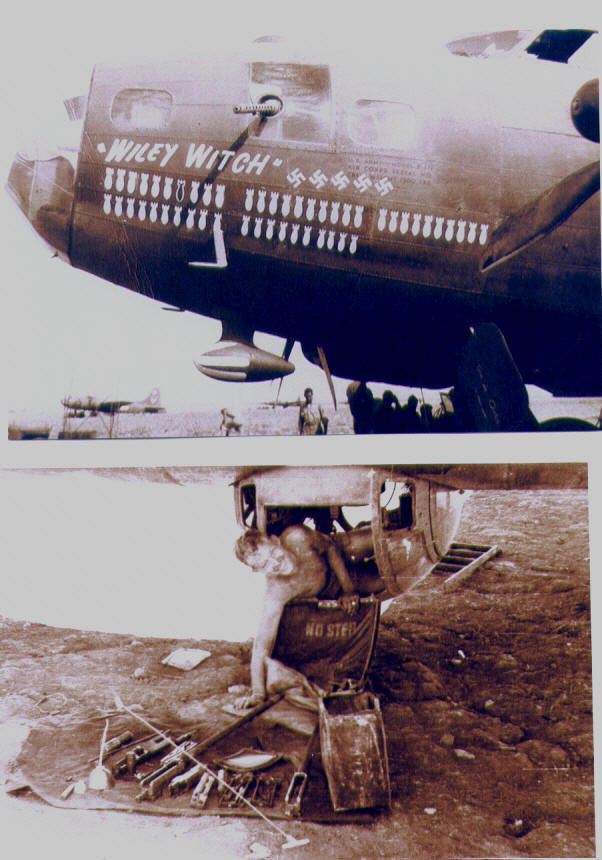
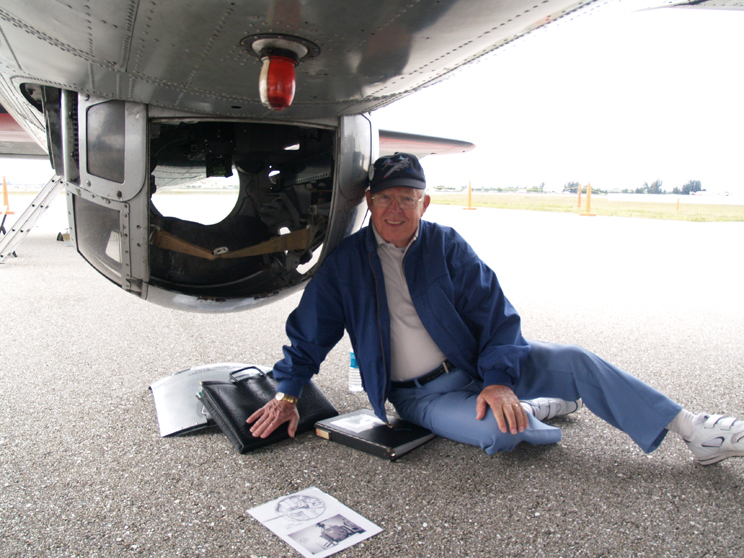
Last Feb. 1st, 2007, the B-17 "Nine-0-Nine" was here in Ft. Myers, FL. and I was the tour guide for the plane. While I was talking to a High School Class, a young man came by names Joseph Gunther, he is a publisher of Children's Books, from Osweego, N.Y. He was taking pictures and taking notes of what I was saying. When he got back home he put together a web-sight and recently sent me a copy of it. |
 |
 |
Posted 2/3/08
Subject: Death Over Sofia
My father, Sgt John Stokan (Jake 2) was in the 96th Bomb Squadron. He wrote this after Mission #170 (March 30, 1944 to Sofia, Bulgaria, Industrial Center) where his best friend Raymond Bringolf (Jake 1) was killed. I don't know if there is a place for it on your website but I think it reflects what these guys went through. There is a page missing that I did read as a little boy and it was a very painful description of this mission and the lost lives. This was written in 1944 and it shows what these airmen felt at that time. Their plane was "Catherine the Great" (a.k.a. #231458 Ole Kate).
Frank Stokan
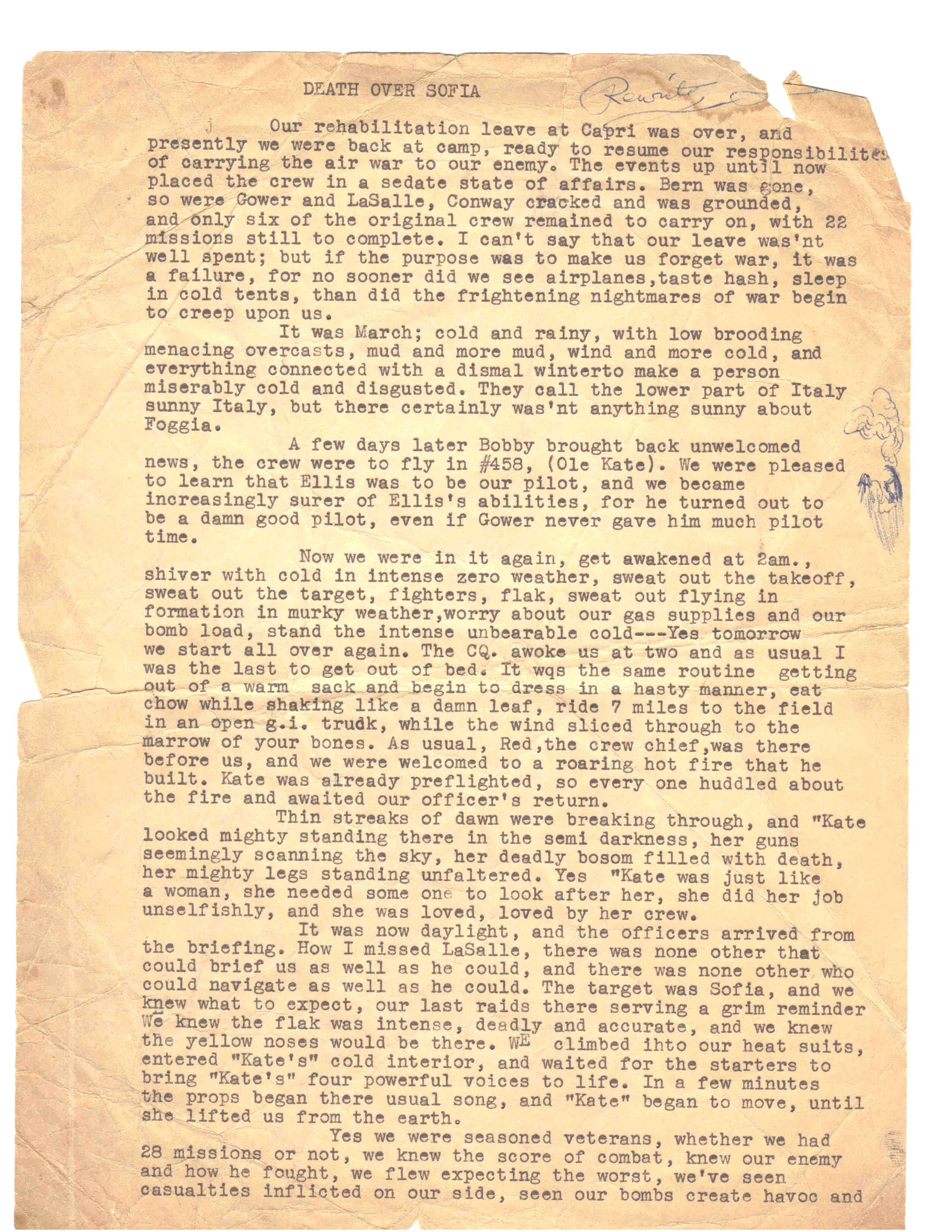 |
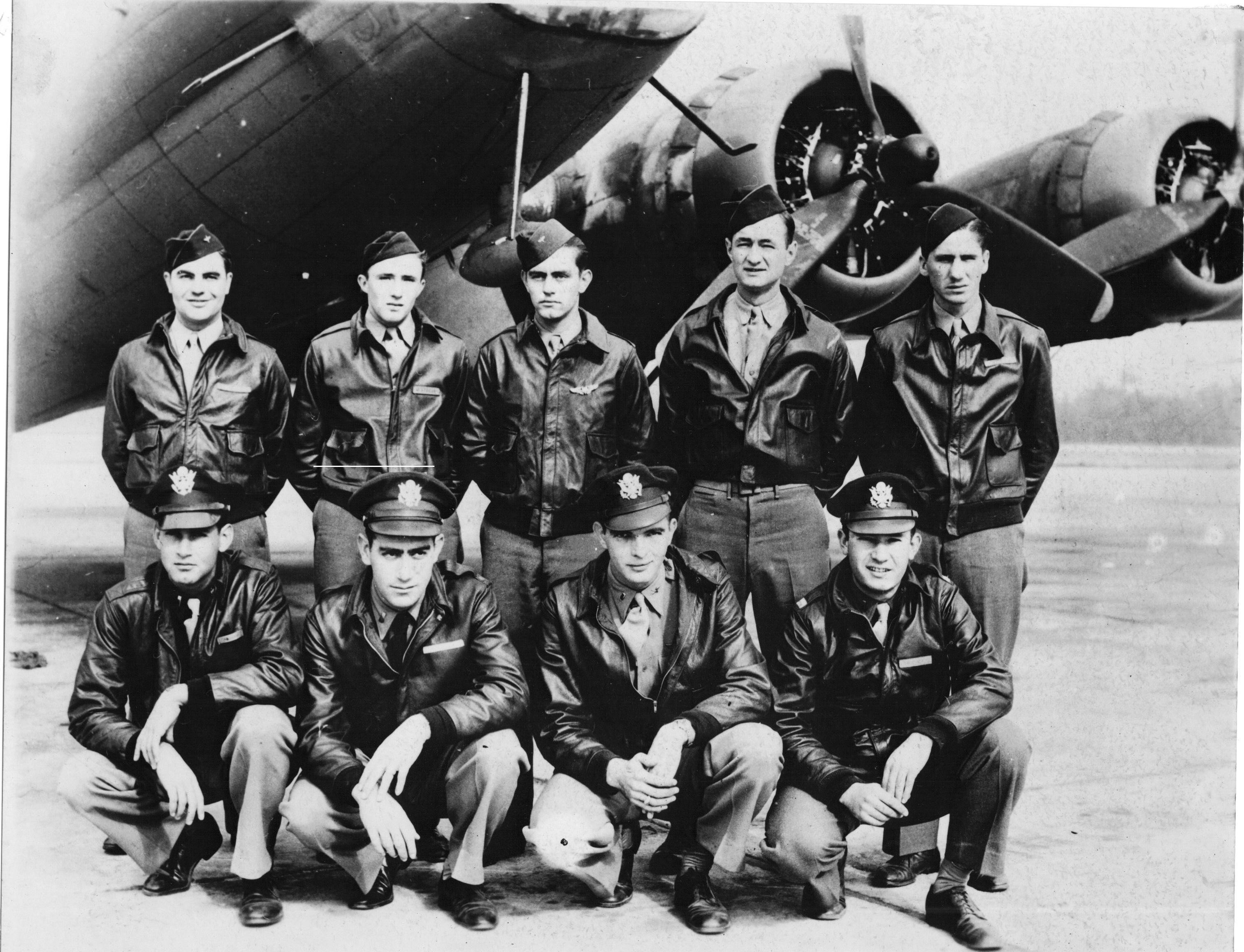 The Crew of "Catherine the Great" |
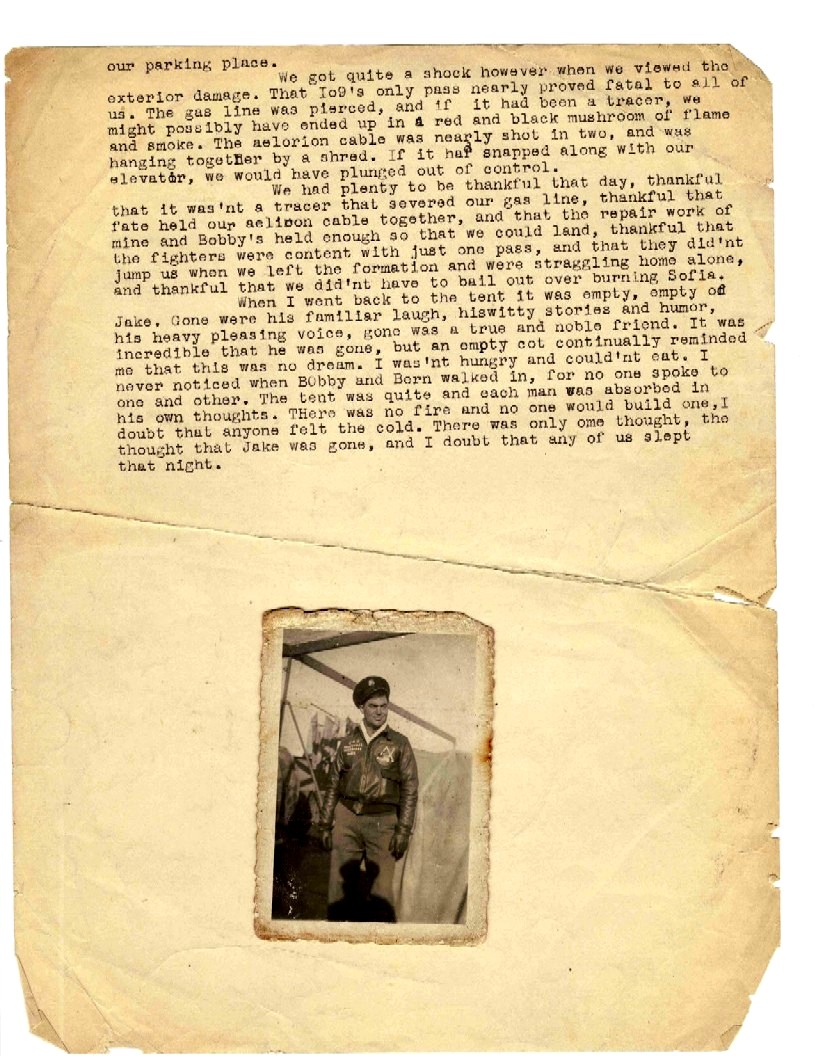 |
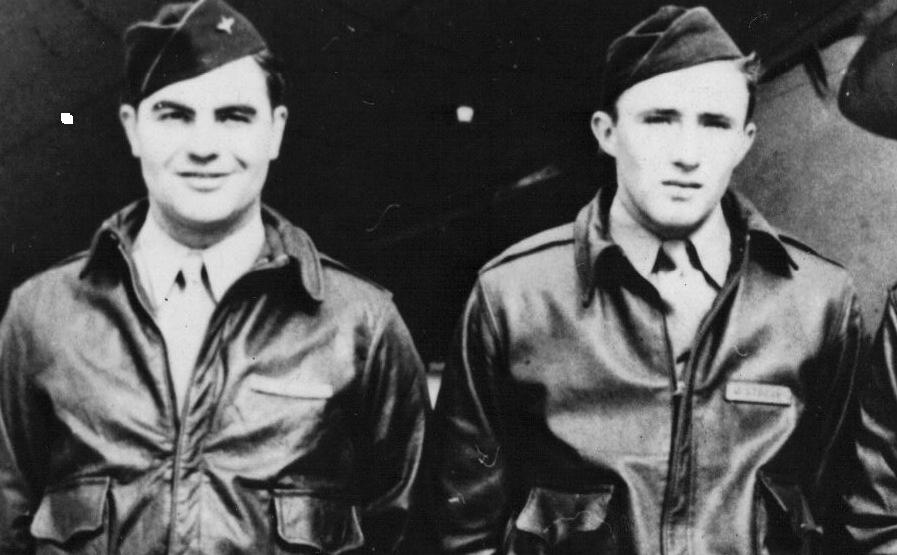 Ray Bringolf (Jake 1), John Stokan (Jake 2) |
Posted 1/7/08
Subject: Joseph L Myers, 429th SQ, who was KIA on the 15th mission over Comiso, SI on May 26, 1943
I'm looking for information and photographs of a family relative, Joseph L Myers, 429th SQ, who was KIA on the 15th mission over Comiso SI on May 26, 1943. He was a member of the William H. Mayer crew.
Mayer, William H - Pilot
O'Connor, Roderic D - Pilot (for the 15th mission)
Wernich, Paul W - Co-Pilot
Angiolini, Aldo - Navigator
McClain, Elmo F - Bomb/Togglier
Davison, George H - Eng/Top Turret
Lundberg, George S - Radio Operator
Lavine, Harry - Ball Turret
Nash, Albert L - Waist Gunner
Samora, Joseph D - Waist Gunner
Any assistance you can provide would be greatly appreciated. Please contact
me at 802-482-4210 or vermontmartins@mac.com. Thank you.
Sincerely,
Stuart R. Martin
Hinesburg, Vermont
Posted 9/19/07
Subject: Lt. Francis Flynn
I am trying to locate info on Lt. Francis Flynn. I have read "Mission No. 263" and the info pertaining to the 50th Commemoration, Aug.28, 1994 that he attended. Loy Dickinson has since informed me that Lt. Flynn has passed away. However, I believe that his sister accompanied him on the trip to Czechoslovakia. I would like to know if anyone would happen to have her phone number and/or address. I believe that they were from the upstate NY area. The reason I am interested is because Lt. Flynn and my uncle, Lt. William Nabinger, 20th/2nd/15th-Mission 227, Jul 7,1944, went to flight school together and were crew members together. It would indeed be a honor to met and or talk history with his sister.
Thank you for your assistance.
Tim Mahar
123 Viilage Circle
Jupiter, Fl. 33458
Ph: 561-747-1543
Posted 4/14/07
Dear Mr. Martin,
I am the very proud daughter of Cletus and Ed Hardy who now reside in South Carolina. They are members of the greatest generation our country has ever known- the World War II Generation. We have just recently found your web site and organization!
My Dad is a new member to your 2nd Bomb Group Association and we are eager to help him enjoy participating in your activities. We were hoping that you may be able to connect him with the other members of his entire crew.
Every mission was heroic for all of the men in the WWII B-17's, with enemy radar, flak, enemy planes with their fire power, and the uncertainty of engine failure, or mechanical failure. Each time they took off, they were putting their lives on the line for their country and families. It was just up to Almighty God as to whether He would take them up on their offer. The stories of heroism would not be complete without including those men who continued to offer, mission after mission, without ever having to endure the horrors of a downed plane, or being taken prisoner by the enemy. For those heroes, our country can never repay the debt we owe. But for the heroes who are not as well sung; our country needs to sing for them too.
Here is how my Dad describes his experience and the pictures (not shown, couldn't be downloaded) I am sending to you.
"I was a member of the 15th Air Force, 2nd bomb Group, 96th Squadron stationed in Foggia, Italy. I was born 6-19-24 and was in the class of 44D pilot school. My training was in California. In my final month of training, I contracted Mononucleosis, (you probably know Mono was called "the kissing disease") and ended up in the hospital for 2 months before earning my wings. Because of this delay I did not go to England and the 8th Air Force with my original class but went on later to Italy in the 15th Air Force. This hospital stay probably saved my life. I arrived in Italy in 8-44 and the war ended 6-45. I flew about 11 missions.
I have enclosed 2 photographs. One shows our officers and crew members plus our plane in 1944. It was taken just before we left for the war. The other photo shows the 4 officers while at a reunion in New York City in 1984, posing the same way as they did in 1944. Note even the hand position is the same as the original picture which can be seen in the foreground. From Left to Right are Ronald Thompson, pilot (deceased); Maurice Edward Hardy, pilot; Wayne LaPoe, navigator (deceased); Ernesto G. Balloni, bombardier (address and condition unknown). "
Here are some stories.
During the first year of aviation training the cadet flies first, in a Piper Cub. Then the cadet flies a Steerman training plane. After learning enough to fly solo, the cadet completes a variety of maneuvers until he can do masterfully. It’s up to the cadet to accomplish everything in safety. Upon one such training flight, a cocky young cadet maneuvered splendidly with growing confidence and grace. No maneuver was beyond his young manhood. During his practice after takeoff, he did a shondell with the wing up to the left and then a shondell to the right, ascending, descending and landing. Mission accomplished! Only then did he realize he had forgotten to fasten his seatbelt! If he had tried to do a loop the young fighter pilot would have fallen right out of the plane! Never again did cadet Ed Hardy forget to put on his seatbelt!
Ed Hardy was determined to learn all that was necessary for any mission he was called upon to perform. During another practice exercise with instructors looking on, he maneuvered his Steerman with precision. As the plane leveled parallel to the ground and he was coming in for a landing, the tires touched the ground for the first bump of landing. The entire plane flipped upside down tail over end with a body and soul jarring impact. The cadet was saved from death because he was in a Steerman and the upper wing prevented a crushing catastrophe. Upon investigation it was shown that the brakes locked. He was blessed by God a second time to walk away from a mechanical failure.
During Air Force training our young men will sometimes cut up and need a little discipline. Our cadet got into a little trouble with his superior officer. His answer when he was called on the carpet was “no excuse sir.” He had landed too far up on the runway, and the officer wanted him to learn a valuable lesson. He gave him a difficult punishment that was going to take him a long time to accomplish. He would be outside in the sun for a long time doing this one. With nothing more than a stick to measure with, he was ordered to find the length and width of the airfield runway. The officer expected to watch with satisfaction this whippersnapper try to manage that one. The officer checked periodically on his progress. The cadet was walking smartly around the airfield with the stick up on his shoulder! The officer was puzzled as to what the young man was doing. In what seemed like a relatively short amount of time, the cadet seemed to be finished. The officer called the young man back into his office and was surprised to see what seemed to be the correct answer. Angrily, he demanded to know how this young man had come up with the answer from just walking around. Cadet Hardy responded that in the US air force they are taught to correct the civilian stride. They learned to walk evenly with the right step and left step. Each stride becomes uniform. " I measured the stick you gave me and then I measured my stride according to the stick. Then I counted the number of strides for the length and width of the airfield and multiplied- Sir!" The officer had to admit that by measuring his stride the young man had made for himself a clever way to measure. The cadet earned his superior’s respect on that day.
After earning his wings, Maurice Edward Hardy was an officer in the US 15th Air Force. He was assigned to a B-17 flying fortress and crew. They were sent to Foggia, Italy. According to his orders he flew the missions his country asked of him. He was one of the country's youngest pilots. He was, however, able to get a full pilot’s rating while in Italy. As such, he was co-pilot on one particular mission. It took hours and hours to reach their targets. On the journey there and back, the B-17s would fly in tight formation. Gigantic flying fortresses huddled together required attention to details. The men who flew them for uncounted hours were in their late teens and early twenties. In one such hour, pilot Ed Hardy’s responsibilities were not for flying. It was his turn to be responsible for the instruments and gauges that help control the B-17. The other pilot was flying at the time. Officer Hardy’s attention was engaged elsewhere when the pilot reached casually over to him and tapped him on the shoulder. He did not immediately respond. Tap tap the finger repeated. He thought, “Yes, yes, in a minute.” Tap, tap, tap, a little harder. The noise inside the plane was deafening. There’s no way to hear someone speaking. The pilot pointed out the window in a gesture meaning “check where we are in formation, look out the window.” The young American Air Force officer glanced out at formation. Adrenaline took over as the co-pilot grabbed the controls. The lumbering B-17 swerved in a manner much too sudden for it’s design. Officer Hardy may have just saved the lives of everyone on both planes. He had seen that their plane had drifted out of formation and was located right on top of the lead plane! He had reacted to an imminent collision with the leading B-17! When they were safely on the ground the pilot and co-pilot came to an agreement. Ed Hardy strongly emphasized, "If that ever happens again, don’t tap me, punch me!”
Here are these stories- short- but full of the realism of just how young these men were as our country leaned so heavily on them. My Dad would love to see it on your web site or the newsletter. He would love to connect with other veterans. With these hopes in mind, I submit his stories.
Sincerely,
Marion Grace
j_mgrace@cox.net
Posted 12/7/06
Dear 2nd Bomb Group Members,
Don't know if you've been copied on the status of the ball-turret gunner found August 29, 2006.
Here is an e-mail from Roman Susil a friend of "Jersey Joe" Owsianik.
Todd Weiler
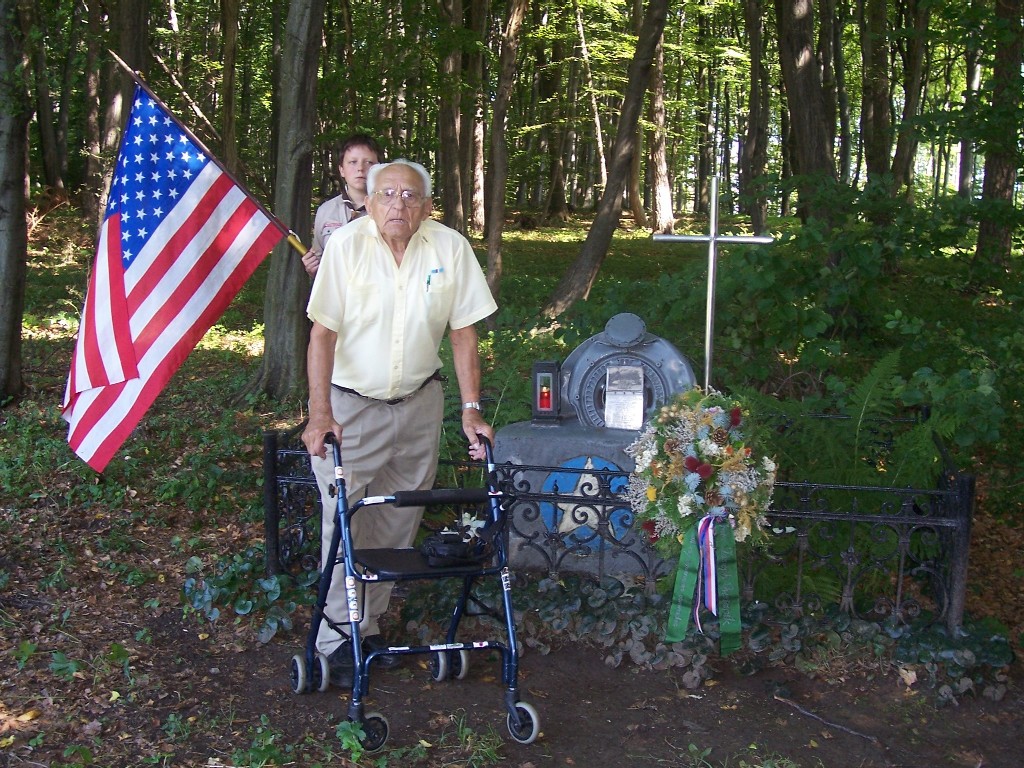
>Date: Fri, 6 Oct 2006 08:58:18 +0200
>From: "Roman Susil"
>
>Dear Todd,
>
>regarding the ball turret gunner- it´s a little bit complicated and sad
>story but I can try to explain it with my poor English... After
>B-17 # 096 fell down near Sanov some citizens went to this crash place.
>One of the citizens found some fingers and part of someone´s head...
>But very soon there came the German soldiers to this spot to collect
>the rests of this plane and the bodies. So this man was hiding behind
>the trees in the meantime and was waiting what´s gonna happen. After
>Germans left this place he went back to this place and found out that
>the rest that were found by him are still there and Germans haven´t
>seem them. So he went down to Sanov and asked the mayor what to do with
>it. The mayor didn´t know so this man went back, put these rests into
>the small wooden box and buried them on the crash place. This is the
>story from 29/8/1944. After the war people from Sanov put a small
>wooden cross on this place. In 1970 they made there a small concrete
>monument with the part of the wing & turbocharger from this machine and
>put a new stainless cross on this place.
>Attached you can see the pictures of this place that were taken last
>year during Jersey Joe´s visit.
>As I told you Jersey Joe has sent a metal detector to Michael Zitnik,
>that is the owner of the museum in Sanov, and Michael went there with
>it. He found there some metal pieces in depth of 23-24 inches. So he
>discovered the ground and found there also the rests of oxygen mask,
>headphones,glasses, shoe sole from the electrical heated boot, little
>pieces of temporal bones and part of hip.
>Believe or not, this happened on 29/8/2006!!! So Michael called for the
>newspaperman on Friday and on Saturday you could read an article in
>Zlin newspapers.
>So in fact it means so after the crash the ball turret and the ball
>turret gunner body were split into a lot of pieces but Michael has
>found the exact place were the ball turret hit the ground...
>
>Bye bye
>
>Roman
Posted 12/7/06
This a copy of an e-mail that was sent to me by Perry Giles today.
Perry has written this article. I think some could be interested in it as
John Adair was the member of the #048 B-17G that went down on Aug. 29th 1944
near Krhov, Czech Republic, during the mission 263.
Roman
taken from the personal letters of John Adair and eyewitness accounts from the book "Mission No. 263"This story will run in our local newspaper, the Waxahachie Daily Light this Sunday.My name is John Hiram Adair. I was born in a white frame house in Forreston, the youngest of five children, and the only son of Johnie and William Adair. We lived on a farm a few miles east of town on Bullard Hill, and were members of the Forreston Methodist Church.
During the summers I helped out Dad on the farm. I went to school there in Forreston until my junior year, when my family moved over to Avalon. My friends from school call me Johnny, but my family calls me "Johnsy".
After graduating from Avalon High School, I went to Texas A&M College, where I joined the Army Reserve in December of '42. After one year in college, I was called to serve in June of '43, and I reported for active duty in the Army Air Corps.
My initial training was at Sheppard Air Field in Wichita Falls, and after that there was more training in Florida and then in Kingman, Arizona at the Aerial Gunnery School. Like a lot of the other "country boys", I was trained as a gunner, because we were better shots than those city boys. We did a lot of shooting at moving targets to hone our air-to-air firing skills.
In May of '44, it was on to Iowa at the Sioux City Army Air Base for combat crew training. When we arrived, they welcomed us with a band. Guess they thought that we needed a pepper-upper since we're fixing to go over in a couple of months.
I've been assigned to heavy bombardment and will be flying on a B-17 fortress. I'm with a good bunch of fellows and like them all fine so far. In my crew, we have four from Pennsylvania, one from Virginia, one from Massachusetts, one from Georgia, one from Wyoming, and the navigator is not with us yet. I hope he is from Texas.
At first I thought that I'd be the right waist gunner, but later I found out that I would have to take the tail guns. Being the tail-gunner was pretty rough. Known by some as "Tail End Charlie", it was a difficult spot. It was a tight little space, with lots of vibration, noise, cold, flying for hours down on your knees, with your legs doubled under you, and looking out through my small plexiglas box window.
Before takeoff, all the gunners would gather in the radio room and then after we were airborne, we would make our way to our stations. As the tail-gunner, I had to crawl past the tail wheel, dragging my parachute behind me, and crawl on hands and knees into the tail. Once we made it up to altitude, I had to plug in my electric flight suit to keep from freezing. This was no place for someone with claustrophobia.
One Sunday evening as I was leaving the mess hall, I looked up just in time to see my good friend from home, James King, walking past. We went to the PX and had a long visit. I hadn't seen him in 14 months, and it sure does a lot of good to meet someone that you used to run around with.
This Iowa countryside is some beautiful land for farming. The land is real black and these farmers have a corn patch for every cotton patch that we have back home. They have the nicest homes and more big barns and outhouses than Carter has liver pills.
I was supposed to make Corporal on the 15th of June, but it didn't come through. My pilot messed up the paperwork. I sure could use the extra pay, it will be $28 a month more.
On the 20th of June, we went on a high altitude gunnery mission over Rapid City, South Dakota, and I got sick as a horse. Riding the tail is certainly no picnic. I would much rather be a waist gunner.
I wrote to my folks and my sisters at every opportunity and very much anticipated all their letters from home. We were due a furlough before we had to go overseas, and I really looked forward to the chance to visit home once more after all this time living in crowded barracks. My leave finally came at the last of July, but it flew by before I knew it.
The first week of August our group received our orders and headed out for Europe. It was a long journey with many stops along the way. Once I was locking the tail wheel and I inserted the crank too soon, and got a real blow on the chin. It bled a good bit, but an inch higher and it would have knocked out all my front teeth. Don't think that it will leave a scar though.
Along the way, we spent some time in the far Northeast. On August 9th we went swimming in one of the lakes up there and the water was really cold. We even did a little fishing and caught some small trout. I'll bet that there are a lot of lakes up there that have never even had a hook in them. It would have been swell if we could have stayed there a little longer.
By this time I had made Sergeant, and was drawing base pay, flying pay and a per diem for being away from my home base. I could take a lot of days like this at $10.30 a day, and I don't care how long I'm gone at this kind of money.
After several days of hard flying we finally arrived at the Amendola Airfield near Foggia, Italy. We were now part of the 2nd Bomb Squadron, 2nd Bomb Group of the 15th Army Air Force.
It was pretty good here, enough to get by on anyway. I live in a tent with six other boys on my crew. We can fix it up in time so it'll be pretty nice. The food is much better than I expected, in fact it's better than lots of places that I trained in the States.
One day I went swimming in the Adriatic Sea, and I am getting a rather nice tan here on the east coast of Italy. We visited Foggia one day and its just awful, all the filth as such I've never seen before. Those people don't have enough to eat either.
It was now the 19th of August and I haven't been sent on a raid yet, but it won't be long now from what I hear. We all looked forward to mail call more than anything else. Mail means a lot over here.
To my disappointment, my crew was split up as replacements for the other crews in the squadron. Oh well, I have no choice to make the best of the situation.
And then August 22nd came my first mission. I was flying tail-gunner aboard the "Tail End Charlie" on a mission to Odertal Oil Refinery in Germany. The pilot was Charles Beecham, and I didn't get to know most of the other guy's names... I had a real case of the butterflies.
It was an 8-hour mission. There were no fighters in sight, but there was lots of flak over the target. The other guys said that it was only moderate flak, but it sure seemed bad to me... We hit the target real good.
My 2nd mission came the very next morning aboard the "Lovely Lady" piloted by Lt. L. D. Campbell. The target that day was an industrial area at Vienna, Austria. This time there were German fighters making attacks through our formation. I'm not sure I hit anything though. At 400 mph, they were a lot harder to hit than the targets we shot at back in Arizona.
I had been told, and today I saw firsthand, that those German fighters really came after us tail-gunners. They knew that if they got the tail-gunner that our B-17s were just a sitting duck. I don't recall ever having the jitters so bad in my life.
On the 24th I went up again, for the third day in a row, this time flying with 2nd Lt. Thayne Thomas on the "Big Time". The mission that day took us to the oil refineries at Pardubice, Czechoslovakia. It was a long, long haul, and I saw a B-17 that had fallen behind the group get shot down by fighters.
The next four days I was off and spent a lot of time in the sack, as I was fairly worn out. I felt as though I was getting into the groove of this and doing a little better each time, but still it takes some getting used to with people up there shooting at me for three days in a row.
On August 29th we were rousted out of bed at about 0330 hours. I stumbled over to the mess hall, but I can tell you that powdered eggs before 4 A.M. are not that appetizing. At the mission briefing we learned that our target for today was the Privoser Oil Refinery and the railroad marshaling yards at Moravska Ostrava in northern Czechoslovakia. Today I would be flying with 2nd Lt. James Weiler on board the "Queen", but today I would be the right waist gunner and that was OK by me.
Finally, I wouldn't be back in the tail all by myself, and I quickly made friends with the left waist gunner. His name is Loren Byam, and he is from Wisconsin. I overheard some of the other guys say that today would be a milk run... Hope they are right.
A few minutes before 0600 hours we started our engines, and at 0614 the lead plane started rolling down the runway. All the others followed in thirty second intervals. As we climbed, we formed our seven planes into squadron formation and then the four squadrons maneuvered into a box formation, which provided the best defensive cover. These twenty-eight B-17's made up the 2nd Bomb Group.
By the time all the different groups of the 15th Air Force fell into line, there were 599 heavy bombers and 294 fighters on this mission. My group was flying tail end of the whole wing, and my squadron, the 20th, was flying tail end squadron in our group, so there we were, right at the very back of this whole combat wing.
We headed north over the Adriatic Sea and had some cheese and crackers before gaining too much altitude when we had to put our oxygen masks on. Gradually we climbed to 28,000 feet. Our flight path took us over Yugoslavia and Hungary, and all was going well.
During the long flight our formation had stretched out considerably. Our group was lagging behind the others, and for some reason our squadron could never catch up with the rest of the 2nd Bomb Group and get into proper formation. On top of that, all of our fighters had gone ahead to clear out the air over the target.
Our radioman had put Axis Sally on the intercom to listen to her music program. Then she broke in over the music and said "Good Morning to you men of the 2nd Bomb Group. Today's your lucky day. Today you get shot down, but before you get shot down, I want to play you a song." It was called Franklin D. Roosevelt Jones. After hearing that, you could have knocked me over with a feather.
Just as we approached the I.P. (initial point) of our bomb run, the pilot called back for us to test our guns and put on our flak jackets and helmets. It was about then that we spotted a lone German fighter following us at a distance. He wasn't moving in, he was a spotter... We were being dogged!
At about 10:40 we were over the White Carpathian Mountains and flying at 22,000 feet. And then it started... Out from behind a cloud formation came wave after wave of German fighters, at 4 o'clock high. They were ME-109's and FW-190's, and their wings winking at me, was my first realization that we were being shot at.
All of the sudden there were tracers flying right past us, and wild chatter on the intercom. As I started to fire back, I saw "My Baby" on fire and start to go down in a flat spin. Fighters went screaming right past us. Then "Tail End Charlie" rolled over and exploded in a giant ball of fire.
I fired back at them the best I could... There were just too many. Must be 80 or 90 of them all around us! They came at us from every conceivable direction.
Shellfire started to explode all inside the plane. They were shooting 20mm cannons at us, and holes appeared in our wings and in our fuselage. A fire started on the wing! Our bomb bay doors swung open and the bombs were jettisoned.
Control cables started snapping all around me! I was hit and went down! Our plane started down on a leftward spiral. The intercom was dead. Acrid, thick smoke filled the inside and the plane shuddered and shook as she took more hits.
We started into a steep dive, and I had to grab on to something to keep from sliding forward. Maybe the pilot is diving us to put the fire out...
Our plane plunged down through the clouds picking up speed. Our co-pilot was the only one that was physically able to bail out before we hit.
It was a Tuesday, the 29th, and I was only 20 years old.
Our 20th squadron was wiped out that morning, all seven planes.
Remember us, for we were soldiers once, and young.
*The bodies of 28 American flyers were gathered and taken to the cemetery in the small town of Slavicin, Czechoslovakia and buried in a mass grave. Although their bodies were removed after the war by the U. S. Army, the local Czech people, who viewed these men as liberators, still hold a memorial service at the site every year on Aug. 29th. The monument that they have erected to the American flyers ends with this verse, "And their ashes have returned to where it came from, and their soul has returned to the Lord who gave it to them".
The Story of Skippy
The following picture of Skippy and his story of service was sent to us by Brian and Beverly Sullivan
(Recent note from Burt Thorman which helps complete the story.)
Dave: After my first visit to the website, I realized that the story of Skippy was incomplete. When the Group came into the Field, Skippy would race down the hardstand for Spinning's plane. The day that Spinning did not return, the dog was disconsolate and finally returned to the tent area. The next day or so, the Groups had him charging down to the hardstand, only to be disappointed. After that, hearing the planes returning, he would start to get up and then stop and sag in sorrow. It was a very sad thing to watch, until someone going home took him back to Peg Spinning - Burt Thorman
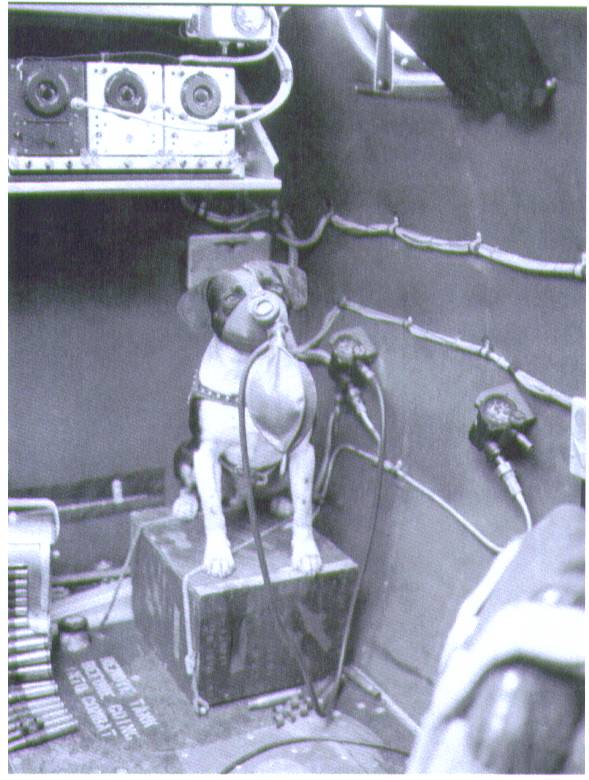 |
 Ken W. Spinning and Skippy |
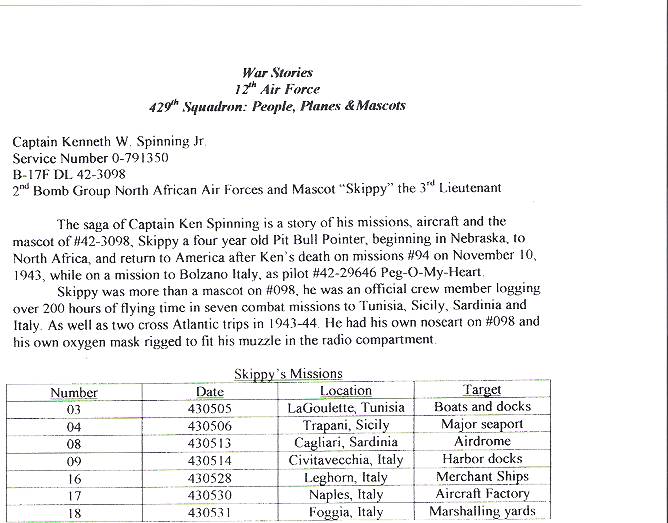 |
|
In a June 2005 interview with Al Nash (429th Tail Gunner in Little Butch #42-29594), he recalled as mission intensity increased, Skippy became gunshy because of the amount of noise and clutter from nearby .50 cal's and had to be grounded. He would always be available when his master would prepare for a mission. The ground crew would have Skippy view the takeoff and he was always available for the landing.
Special Note !
January 27, 2005
Dick Drain from the 99th Bomb Group in Italy has assembled a listing of all crews in all the Groups of the 15th Air Force. He has offered to let the 2nd Bomb Group use a copy of this list covering the crews of the 2nd. This will give us the ability to access this database for information about any flyer, crewman, mission, aircraft, and target flown by the 2nd BG from April 1943 to May 1945. We will keep you advised of progress.
February 13, 2005
The following message just received:
This letter received by Loy Dickinson on February 12, 2005 from John Bryner,Jr. recipient.
Any action will be taken by President Dickinson.
Peace Memorial in Grossrachen, Germany March 22nd (Thanks Earl Martin) DFC
Maj. Mark S. Carroll, USAFR
M/Sgt Bryan S. Ripple USAFR
NCOIC, 910TH AIRLIFT WING PUBLIC AFFAIRS
John C. Sullivan - USAFE/HO at Ramstein AB, Germany; Historian
Dear Sirs:
This is to request US Army Air Force representation at the dedication of the Peace
Memorial Monument in Grossraschen, Germany scheduled for noon on 22 March
2005, just 60 years after a B-17 bomber of 2nd BG; 20th BS, flown by Williams
crew, crashed, killing 9 of 10 crewmen and 13 Germans. The six-foot-tall pyramidal
granite monument lists names of victims and the story on it's 3 sides.
The Peace Memorial Monument Committee, consisting of 4 Americans and 4
Germans, after receiving approval and encouragement from the Burgermeister, and
Town Council of Grossraschen are finalizing the Program.
The City of Grossraschen will host the Program and entertain such invited guests
who may represent WW-II veterans of the German Luftwaffe and USAAF, active
US Army Air Force, American Embassy, American EX-POWs, local survivors of
the bomber crash, kin of the aircrew victims, and the only survivor of the crash,
myself, John H. Bryner, Jr.
Names of the Committee members, the Burgermeister, local German Historians
and other appropriate persons may be submitted to you upon request.
Respectfully yours,
John H. Bryner, Jr. Ph.D.
"12th to 15th Air Force" (taken from News Letter January 05 (Thanks Earl Martin)
When the 2nd Bomb Group arrived in North Africa, April 1943, it was
assigned to NASAF (North African Strategic Air Force). It, along with the
newly assigned 99th bomb group, was part of a reshuffling of heavy groups
among England, North Africa and the Middle East.
Later the B-17 and B-24 groups were assigned to the 12 Air Force.
They remained in the 12th until the 15th Air Force was organized in
Dec. 1943 and moved to Italy. The four B-17 groups and the two B-24
groups, making up the 5th Wing, were moved to the 15th. The B-24 groups
were then moved to other wings and the 5th Wing was composed of the four
groups of B-17s. Two more B-17 groups were later added to the 5th Wing.
May 2, 2004:
Today we received a message from James Peters who asked us to post
the following message on the Bulletin Board: Web Master.
"I am interested in talking with anyone who knew my father.
His name was Lester M. Peters and he was with the group from
startup in the US till the end of the war. He started as maintenance
officer for the 96th Squadron. Later promoted to Maintenance
Officer for the 2nd Bomb Group."
"I can be reached at: James Peters 817 Lakewood Blvd
Madison Wisconsin 53704. Telephone 608 246-8575(Home)
920-478-2191 (Work) Email: james peters@trekbikes.com"
Thanks in advance for your help, James Peters.
July 1, 2004
Information about Capt. Wm. J. Cooper
We received a letter from Nancy Hodges whose Father was Capt. Wm. J Cooper. We could not find his name listed in "Defenders of Liberty" or "The Second was First". Nancy Hodges is determined to find a connection between her father and the Second Bomb Group and has sent several pictures taken from her fathers Alban, some of which we could identify as being from the 2nd Bomb Group. Others we could not. We need your help.
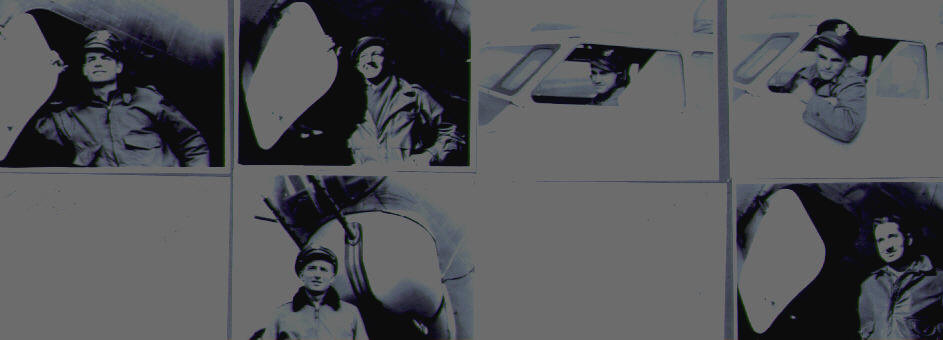
Picture upper left hand corner was identified as 1st Lt. J. Loren Peck Navigator on mission 393 to Munich,
Germany on October 28, 1944. They lost 3 engines but nursed the plane to a crash landing at Falconaro, Italy. The
report did not list any causalities. The second picture was not identified but there was a handwritten marking showing
the name "Schmidt" The third and fourth picture were identified as 2nd Lt. Robert W. Steel CP on crew of 1st Lt. John
W. Pierik's crew of 429th Squadron which as shot down over Ruhland, Germany on March 22, 1945. Steel and all the officers in the forward section of the plane were KIA. The rest of the crew in the rear section bailed out and were
taken POW. All were later returned to the US. Picture in the lower left was not identified. The picture in the lower right
was not identified but the hand written note to the left of it says "Marx".
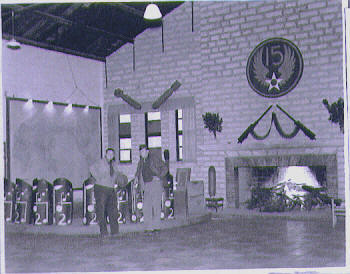
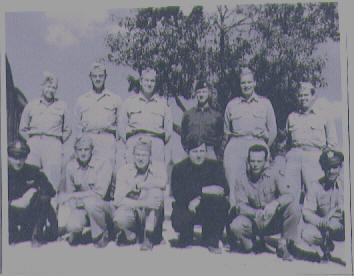
In the pictures sent by Nancy Cooper Hodges we found these two pictures. The Picture on
the left is the Officers Club which was built by the Group Officers. The Club was completed in
April 1944. The officers to the right must have had something to do with the Clubs Construction.
Nancy says that her father is standing on the Left side of the picture.
If anyone remembers any of these men, Please let up know and we will forward your message to Nancy (Cooper) Hodges.
8/5/04
Email from Zebulon Vance Jackson, Jr.
Email received August 5, 2004 From Vance. Jackson
It is with profound sorrow I inform you of the death of my father
Zebulon Vance Jackson of complications from pneumonia on February
10, 2004. Dad was proud to be a member of the 429th with whom he
flew 65 missions as a bombardier. He was the last surviving member
of his crew. He was retired from the USAF as a Lt. Col, and the
USPS as an Asst. Postmaster.
I hope his many friends from the 2nd Bomb Group will remember
his easy-going nature and ready smile with the same fondness as
those who were closest to him.
Zebulon Vance Jackson, Jr.